

For a moment, put yourself into the shoes of a soldier in the contested regions of Ukraine, regardless of the flag flown by your initial thought. It’s cold, wet and the sting of every move creaks off the stiff, overused fabric that imprisons your flesh. You frantically look to the sky and listen for the faint soulless whir of imminent death. This is your reality.
The situation in Ukraine has been shrouded in a cloud of media attention and rumours of peace, while efforts on the ground have continued to sour, sending the state of warfare into an even more terrifying medium. Unmanned, unaware and unassuming, ethically questionable weapons have made a permanent way to the battlefield.
“Drones are the most important military invention since the bullet,” said Ukraine’s deadliest drone pilot, nicknamed “Darwin,” in a featurette for The Wall Street Journal last year.
The News
The war in Ukraine is a stark warning to the rest of the world. It is a reminder that, even with all of our technological advancements and defense spending, a cheaply manufactured quadcopter capable of transporting available ammo over miles of enemy line can strike precisely where it hurts and be completely removed from the morality of presence through a television screen.
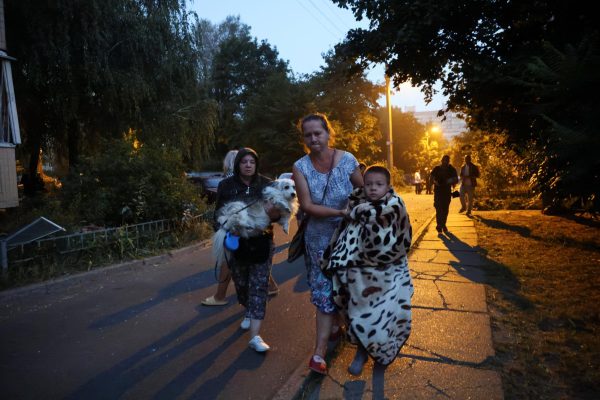
On Sept. 7, Russia launched one of the largest aerial raids on the capital of Ukraine, sending over 800 drones and 13 missiles that killed four, including an infant. The Ukrainian interior defense said that over 20 were wounded, with one explosion setting fire to the main government building within Kyiv.
Two days later on Sept. 9, a Russian bomb detonated in the village of Yarova killing 23 people, most of whom were collecting pension checks at a local post office. Ukrainian President Volodymyr Zelenskyy later called for global support through X, hoping to elicit further support from U.S. President Donald Trump.
Recently, Russian President Vladimir Putin, President Xi Jinping of China and the Supreme Leader of North Korea, Kim Jong Un, met at a military parade in Beijing. Kim contributed troops to Putin’s cause last year, posting a video recently via state-sponsored media, admiring the North Korean troops that served.
This week, President Trump, frustrated with the lack of compromise from Putin, has warned of new sanctions that the Kremlin has since shrugged off.
The Resources
Territory is on the bargaining table for the world to see, almost like reality TV or real estate infighting over the potential of property value. Why has the prospect of peace been halted at every opportunity for advancement? Resources.
The current territory held by Russia in the eastern regions of Ukraine’s Donetsk front contains deposits of rare earth materials: titanium, zirconium and lithium. Titanium is used in many commercial U.S. products, including dental equipment and sporting goods; zirconium is utilized as an essential component for the process of nuclear energy and lithium is used for most batteries and electric vehicles.
Trump began bargaining U.S. support for a taste of mineral wealth abroad, forcing Putin to make his own push towards the pot in mid-February of this year. The front has barely moved, and the momentum lies in internet access.
The Cable
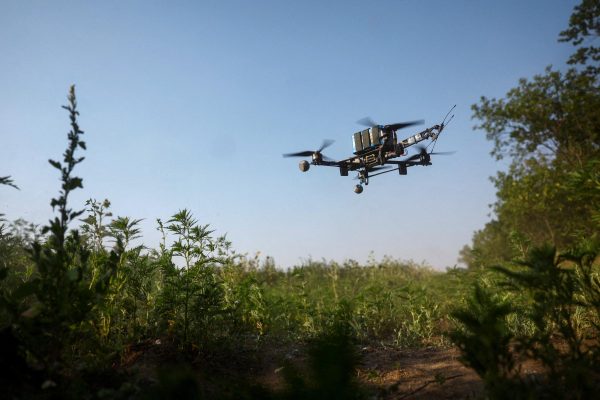
Miles of fiber optic cable riddle open fields, with sunlight reflecting off of them like haunting reminders of the targets that lie at the end of the spool. Drones are more prevalent than the local avian population, and artillery craters carve a new landscape out of forgotten homes. Ukrainian civilians even point out the locations of suspected Russian aggressors to hovering friendly drones.
Fiber optic cable is essential for the current advances on both sides, extending the range of unmanned reconnaissance regardless of jamming efforts. Local industries began switching to military production early in the war, with the primary product being drones and related equipment.
These drones don’t operate like those from most countries, remaining at a designated altitude like the American-made MQ-9 Reaper drone, nor are they the size of a civilian plane. They are much smaller, more reminiscent of a falcon that can dive at a moment’s notice from an unpreventable altitude.
The cable provides a secure connection directly to combat units easily deployed within minutes from mobile sites. This is a strategy that has combatants pleading for their lives into a drone camera from only a couple of hundred feet in the air.
Standard operating procedures for drone warfare do not apply in Ukraine because the warring nations are at the same military capacity. Surveillance or weapon-loaded drones that attack from standard altitudes are easily intercepted.
Russia has worked for decades to establish military might, while Ukraine utilizes emboldened Western equipment and training to stand on its own. The use of drones has had to adapt into a terrifying new strategy: using a hardline of fiber optic cable to bypass modern countermeasures that rely on shared internet access.
The Simulators
Soldiers train for combat operations using first-person view drone simulators that are publicly available for civilian use. Ukrainian companies are actively investing in drone manufacturing and educational training.
A drone simulator school recently opened up in the Ukrainian city of Rivne, offering practical training to residents. Drone warfare has allowed both sides to limit the number of casualties while increasing the level of lethal effectiveness.
Some of these first-person view simulators are available in American video game markets, with players looking to recreate the accuracy of actual combat flight. One such game, titled Remote Reaper, made by game developer Vladyslav Fomenko, has players fly drones into vehicles.
The review section of this game and games like this illicit eerie connections to the dissociation of modern conflict. One comment from a user that goes by Serratus on the platform Steam reads, “If you were ever excited about how Ukrainian soldiers masterfully use them in combat… try this game.” 
The Evolution
Random and unpredictable aerial attacks have forced combatants on the ground to change equipment into anti-drone monstrosities. Tanks, infantry transport vehicles and small trucks have been specifically designed to stop overhead drones.
They use steel, wire and netting to fashion huge makeshift domes over the vehicle, possibly preventing multiple direct strikes from munitions. Many of these units use any available scrap to protect themselves from the sky.
Now, countries across the globe are investing heavily in anti-drone equipment. Jammers, lasers, missiles and specialized backpacks are all designed to disrupt the connection to any drone. Ground units now have to plan for a mass drone attack, and cities install invasion-level protection as most attacks of the sort come in waves.
The evolution of war is remote, not human. The cost of the inevitable direction of war will be great, and there is no telling of the psychological harm the threat of unmanned warfare could cause to our societies.