
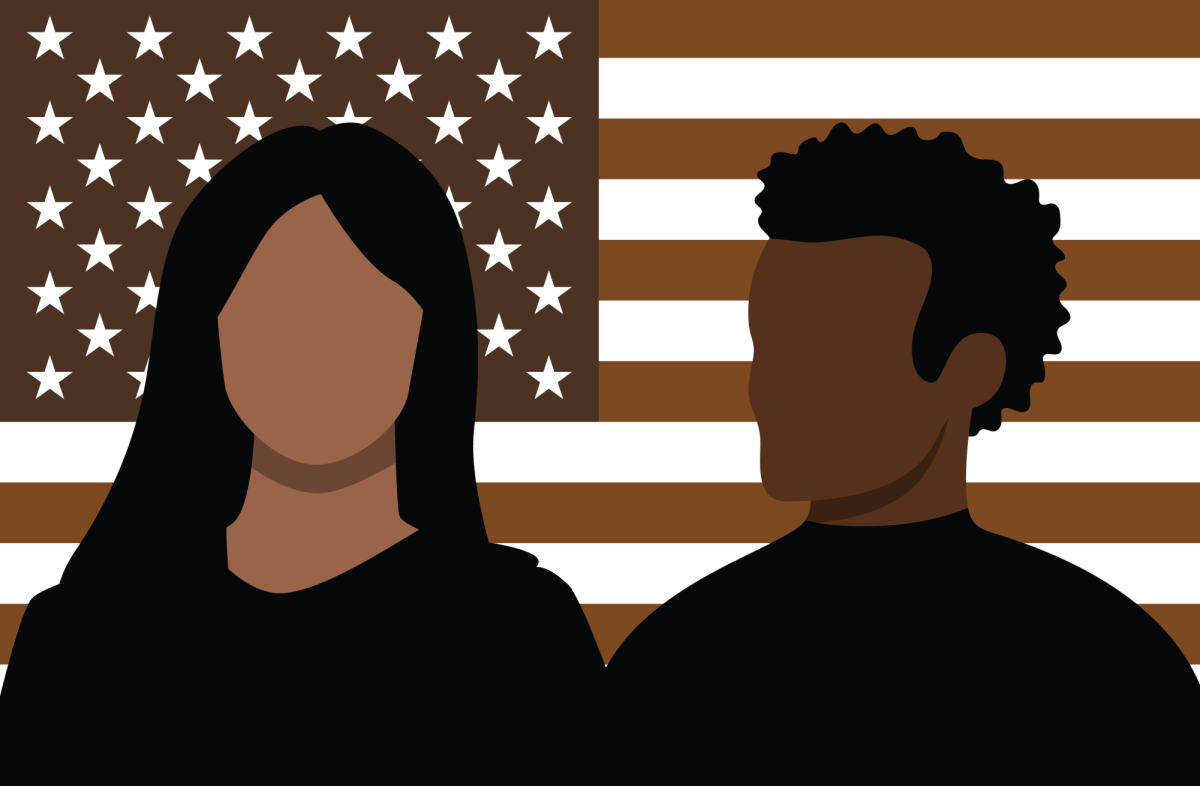
This piece is presented as a conversation between Manjot Dhanda and Chase Davis, Collegian staff members reflecting on their lived experiences and perspectives on identity and perception. The format is intended to highlight both shared and differing viewpoints through dialogue.
Manjot:
Chase, have you ever felt like people already got you figured out before you even say anything?
Chase:
Yeah, Manjot, I actually feel like that all the time. Throughout my life, being African American has always been an important factor in any space that I’m a part of. Some claim to never see race and say that racism was a thing of the past, that we have completely moved past it.
Yet, all of my experiences have shown otherwise, hearing microaggressions and the phrase “Look, I’m not racist, but,” followed by the most outrageous and demeaning comments, is a casual conversation in my life.
The crazy part, Manjot: I haven’t even spoken about the clear racism that is built into what we call a system of justice and fairness for all.
In fact, 47 of 51 signers of the Declaration of Independence were enslavers.
Along with the very pledge that we say for our great country of America was created by Francis Bellamy, who was a racist and believed in keeping a pure country.
Just like that, the foundation some hold dear crumbles back into the dust in which men were made.
Nonetheless, I’ve never wondered why I have to deal with this broken system. Since I was a little boy, my mom has always explained that people will look at you differently because of how you look and that racism will never cease to exist.
Although this has always been a hard pill to swallow, I kept pushing; I refused to be a victim in this situation and attempted to be seen as unbreakable, stronger than the comments and the clear systemic suppression.
I assume you know how that feels, Manjot. Being brown comes with similar struggles.
Manjot:
Yeah, I do know that feeling. It’s different, but it’s also not. Growing up Punjabi, I’ve always been aware that I stand out before I even say anything. Whether it’s my name, my background or just assumptions people make, it feels like people already have an idea of who I am before I get the chance to show it myself.
I’ve heard the same kind of comments too, just said in different ways. Not always direct, but enough to make you pause and think about how you’re being seen. As you said, it’s not just random moments, it’s built into the way people think, the way systems work, the way certain spaces feel.
What stuck with me from what you said is the idea of just “keeping it pushing.” I feel like I’ve done the same thing. You learn to move through it, not because it’s okay, but because you don’t really have a choice. You try not to let it define you, even when it’s constantly being put in front of you.
And yeah, being brown comes with its own version of that. There’s always that feeling of being watched a little more closely or being misunderstood before you even explain yourself. But I think what connects our experiences is that constant awareness. Like you’re always thinking about how you’re being perceived, even in spaces where you should just be able to exist normally.
That’s what makes it frustrating, Chase. Not just the comments or the history behind it, but the fact that it never really turns off. It follows you into spaces where it shouldn’t even be a factor in the first place.
Do you ever feel like you have to change how you act or present yourself depending on the space you’re in, just to avoid being judged a certain way?
Chase:
Man, all the time. Whether in a professional setting or casual setting, I’ve always noticed how people look at me differently. In return, I’ve always entered those rooms with the mindset of holding myself to a higher standard than others.
For example, at my job here at The Collegian, I’m the only African American paid staff member. When I first arrived in the newsroom, I was greeted and welcomed with open arms.
Yet, because of my life experiences, I feel like I always need to keep my guard up and act more professionally than others do.
This especially pertains to controlling my emotions; if I don’t, I fear others will see me as the big, angry, unapproachable black man.
For casual experiences, Manjot: Imagine yourself doing a simple task like walking in the grocery store for snacks while store workers look at you more intently and follow you around. This is a very common experience for me throughout my life.
How do you express yourself so unapologetically? With the unintelligent brown women trope hanging over your head.
Manjot:
Yeah, I get what you’re saying, but I don’t think being “unapologetic” is as simple as it sounds.
There are definitely spaces where I feel like I have to adjust, even if I don’t want to admit it. Like in professional settings, I’m more aware of how I talk, how confident I come off, and even how serious I look. Not because that’s naturally who I am all the time, but because I know how quickly people can make assumptions.
And that stereotype you mentioned, it’s real. I’ve felt it in classrooms, group projects and even just introducing myself. There’s always that split second where you can tell someone is trying to figure you out based on your name or how you look before you even speak. It’s like you’re starting from behind and have to prove you belong.
So when people say “just be yourself,” it sounds nice, but it’s not that easy. Being yourself can come with consequences depending on where you are and who you’re around.
At the same time, I’ve gotten to a point where I don’t want to keep shrinking myself just to make other people comfortable. If I’m constantly adjusting, then what version of me are people actually seeing?
What you said about controlling your emotions stood out to me, especially in professional spaces.
Chase, have you ever had a moment where you didn’t hold back and just reacted how you normally would? And if so, how did people respond to that compared to when you’re more controlled?
Chase:
Wow! You’re reaching deep here, and I love it, Manjot. I’ve had so many moments where my emotions wanted to pour over. I think what you’re speaking to is not holding back and stating my raw emotions.
One example I can think of is an argument I had with a friend about whether there was a need for campus organizations and clubs, such as the Black Student Union and the Black Student Success Initiative, where I work.
During the argument, I, of course, got very passionate and told him that he clearly didn’t know what he was talking about. His reaction to me being upset is something I definitely wanted to point out. Although I wasn’t flipping tables, his tone completely shifted to a more defensive one, as if I were the one who made the comments towards him and was in the wrong for getting angry about comments he was clearly wrong to make.
Through many experiences like this, I realized that I cannot raise my voice or get riled up about a topic without others’ mannerisms changing, because just as you spoke to Manjot, everything I do comes with consequences.
The funny part is when I’m perfectly calm and always react with an understanding tone. I’m congratulated as if they expected me to blow up and scream at others for being wrong. All of my life, I’ve been met with microaggressions like “Wow, you handled that so well.” To many, these may seem like a compliment on the surface, but after so many times, you learn how to identify subtle discrimination.
Over time, I’ve learned that when it comes to actually allowing my real thoughts to be said, it stems from being strong for so long and from letting microaggressions slide that actually bothered me.
For some, I feel like being professional is a privilege; for me, it’s a necessity for how people view me, both at work and outside of it.
Manjot:
What you said about professionalism feeling like a necessity, not a choice, really stuck with me, Chase. The idea that even how you react, something as human as emotion, can be read differently depending on who you are. That’s heavy.
And it makes me think about how much of identity isn’t just something we live with, but something we’re constantly negotiating. As we walk into spaces where people have already decided who we are, we spend the rest of the time either correcting that or trying to fit into this impossible mold.
Over time, that has to shape you. It blurs the line between what’s actually you and what’s been built in response to being watched or misunderstood.
And maybe it’s not something we can fully escape, because it’s bigger than any one person, but I think there’s something in recognizing it for what it is.
Maybe the real question isn’t how we avoid it, but what parts of ourselves we choose to hold onto anyway, even when the world keeps trying to define them for us.
Chase:
Honestly, I agree. I think, even with us sharing our experiences, people will never be able to truly understand, because our truths are too hard for others to expect without making excuses.
I realize more than ever now that we can’t keep letting small parts of ourselves go in order to fit the narrative that we are meant to fill.
At some point, we have to decide to be proud of who we are, regardless of the backlash; only then can we rise above it.