
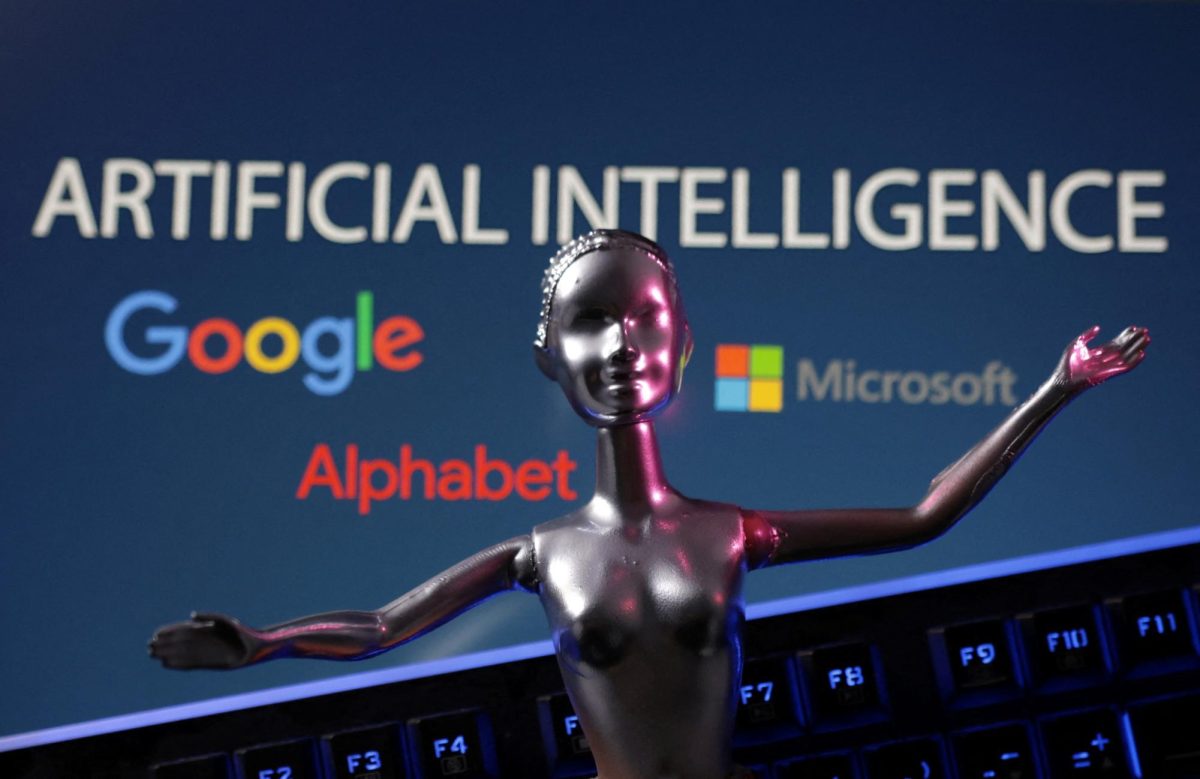
Though the stigma surrounding using AI is a valid concern, it may be causing another problem — a gender gap.
Harvard Business School released a study looking at 18 datasets worldwide, demonstrating a gender gap in AI usage. Women are 20% less likely to engage with generative AI.
You may assume this is due to unequal access to AI platforms, but that is only partially true. The study refers to a survey done in Kenya with 17,000 participants who were given access to learn ChatGPT. The survey showed that women were 13.1% less likely to use ChatGPT. This might suggest that equal access can shorten the gap, but it is not the only reason for this gap.
According to the CSU AI survey conducted last fall, 64.4% of male students believe that AI will play a significant role in their future career, as opposed to 48.5% of female students at Fresno State, further demonstrating that female students are not as aware of AI’s impact on the job market.
From retail to education, AI has already ingrained itself into the market. The less aware people are of AI usage and how to navigate it properly, the more room there is for AI and AI companies to take over people’s autonomy. In this case, women are at risk of being ratioed out.
The pre-existing gap
It’s no secret that tech is heavily male-dominated. Many of the iconic faces of tech, such as Elon Musk and Mark Zuckerberg, have aligned themselves with alt-right spaces notorious for misogyny.
Leaders in the tech industry have been criticized for upholding a ‘broligarchy’ as they hold extreme wealth, power and influence over policy, most recently as they were seen sitting with Donald Trump at his 2025 inauguration.
However, women have been making marks in the tech industry globally and locally.
Lalita Oka, a civil engineering professor, said, “Typically, AI is connected with a lot of technical subjects. For example, in engineering or STEM fields, there are already very few women in that.”
So, it is only natural that there is less female representation in AI.
Bao Johri, Fresno State’s Vice President for Information Technology and Chief Information Officer, said that in recent years, there has been an increase in women in the tech industry.
“Sometimes people need to see that they can actually sit in the world, so representation matters,” said Bao Johri.
Representation doesn’t just matter in what C-suite positions women hold in tech. But it also matters in the usage of tech.
The cycle
AI isn’t a magical identity that gives you the right answer out of thin air. It is an algorithm that scrapes its data from the internet and users to come to a solution that you will like the most. A majority of the data that currently exists on the internet deals with bias, whether it’s gender, race or sexuality.
“I think that people who are working on these [AI] models have to be very intentional about how we move these biases,” Johri states.
But that’s not the only way bias can seep its way into AI.
AI develops for the people who use it. As fewer women use it, the data will train itself on data pertaining to men.
Public perception
The study points to factors such as familiarity with AI, confidence in using AI and perception of the ethics of using AI to this gender gap. According to an AI survey conducted by CSU, 60.6% of female students at Fresno State would be embarrassed if people found out they used AI, compared to 49.7% of male students who would feel embarrassed.
Oka believes women are worried about AI use because they are worried about privacy.
“They know anything goes on the internet, it is able to track you down and eventually detect the patterns you do,” Oka said. “Women are that way, very conscious about their self-privacy and those issues more than men.”
The fear of being called a cheater or being embarrassed by using AI only adds to their confidence levels in the workplace and academia.
AI Usage in Class
Oka is one of the professors on campus who permits AI use in class, and she mentions seeing a notable difference.
“If there are female students in my class, they try to do everything very sincerely, even if I’m permitting AI and they have access to AI,” Oka said. “The men want to be polished and make [an assignment go by] faster,” said Oka.
She doesn’t believe AI usage in class is cheating because she assesses students differently.
“I don’t believe there is going to be only one answer to any problem we are solving,” Oka said. “So if you want to brainstorm, AI is a very nice tool. As a teacher, I’m giving you tools, and AI is another tool. Mathematics, the problems we solve, is a tool. And if it makes it faster, why not?”
Ethics and Impact
When discussing the ethics of AI usage in the classroom, Oka emphasizes that AI should not use AI to replace their thoughts.
“AI is a tool, remember that. It’s not the endgame,” she said.
It wouldn’t matter if women are afraid of using AI, whether it’s the lack of confidence or fear of public ridicule, because AI is still making its way into everyday life.
According to a survey conducted by McKinsey & Company, “62% percent of respondents say their organizations are at least experimenting with AI agents.”
You will get left behind.
“I would encourage all women, especially young women, to really build that capacity to ensure your future will be a success. No matter what it is, there is going to be some sort of AI component,” Johri said.