


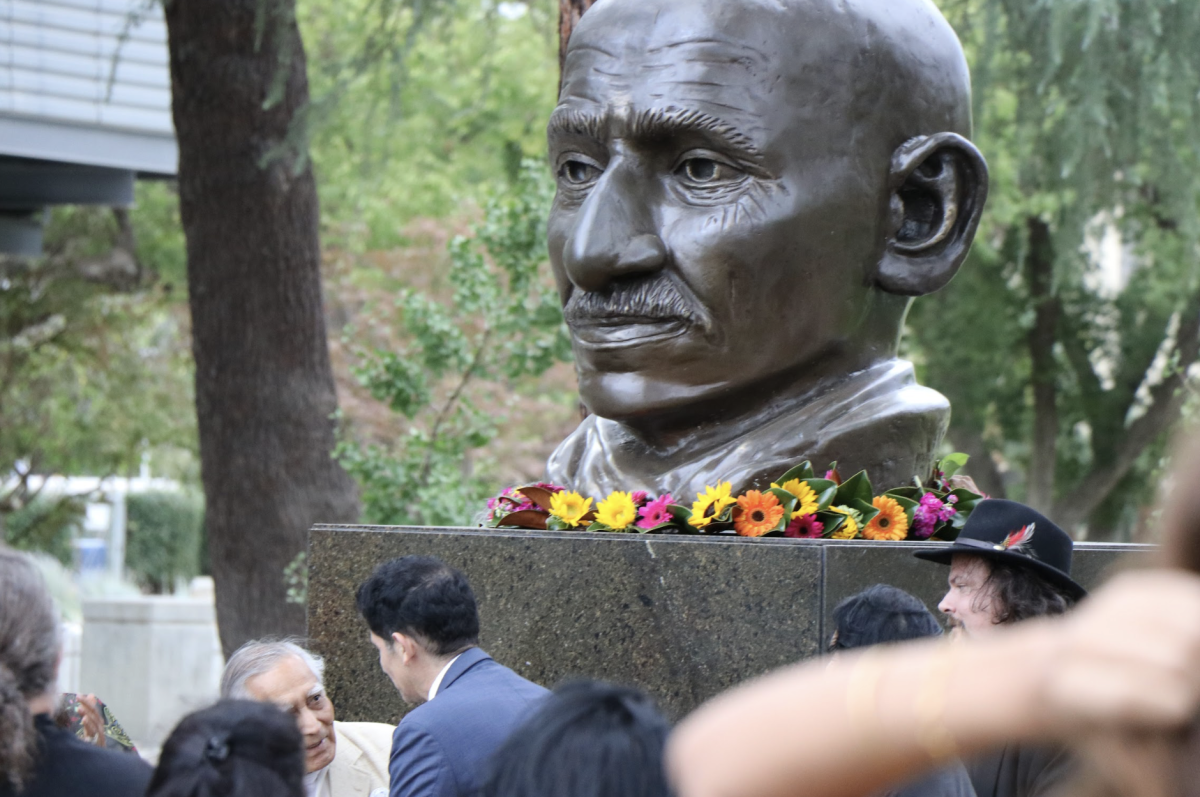
Do you ever get the “ick” from a situation? I do. My instinct “when something feels off” is to avoid. I’ve learned that sometimes that instinct is right, but sometimes it is not. Yet, every time I have ignored my initial conclusion and continued to stay curious, I have learned something. That is what this moment on campus feels like to me: an opportunity to address a cultural norm of removal by instinct.
As a returning Fresno State student, attending the University pre-, during and now post-pandemic, I have witnessed a variety of changes in the student academic experience.
In 2019, I attended Fresno State’s “Gandhi’s Global Legacy International Conference,” where my academic experience was enriched by the voices and thoughts of modern Civil Rights activists, including Dolores Huerta and Rev. James Lawson Jr., the leaders of nonviolent struggles against injustice in America.
I still remember how they spoke of Gandhi’s influence on their work, including some of the most important ideas he propagated in the fight against oppression: truth-force (Satyagraha) and the uplifting of others (Sarvodaya).
Throughout his career, Rev. James Lawson Jr. responded to critiques of perceived racism in Gandhi’s life, drawing on his own lived experience with racism, while still affirming the value of Gandhi’s philosophy of nonviolence.
This was an experience I had to sit with and commit to not rushing to any conclusions. Before deciding if an internal adjustment of my beliefs or thoughts was appropriate, I allowed their ideas to interact with my own deeply held beliefs.
My lesson: patience is a critical factor both in this internal process and externally when using non-violence to create meaningful, sustainable and lasting social change.
This spring, upon my return after six years to Fresno State, the campus feels different, faster and maybe even more reactive.
Things move quickly, especially when something feels wrong, and the perceived instinctual movement is to erase and avoid.
In places of learning and growth, discomfort is inevitable and what we gain from that discomfort is our own power. As campus culture becomes faster and more reactive, universities should resist the instinct to erase symbols erected to symbolize peace, nonviolence and justice.
As a student, I believe we must create a space for deeper learning because understanding complex histories requires time, not a quick removal.
This semester, we have seen calls for the removal of various historical figures on campus by way of social mobilization. All efforts may have a good reason, but my disdain for the typical reaction of removal is not because I disagree with any particular reasons.
However, if we continue to remove statues, symbols or spaces because they represent individuals who, despite their human failings, dedicated themselves to uplifting humanity, how can art and academia continue to provide (visual) ways to explore the complexity of humanity?
These spaces, these statues and these controversies are a starting place for dialogue in academia, an opportunity to challenge our humanistic nature of avoidance of discomfort in place of engagement for growth. The flaws of human history and historical leaders are not unreal, but they also are not all that is real.
After the removal of the Cesar Chavez statue in the Fresno State peace garden in March 2026, we are seeing student efforts that call for the removal of the M.K. Gandhi Center: Inner Peace and Sarvodaya, an educational place located on the third floor of the library. Their discomfort must be acknowledged.
However, I find myself asking: when something feels uncomfortable, do we engage with our reasons and beliefs or simply move to erase it?
Dr. Howard, scholar of nonviolent movements, reminds us that when we center individuals as symbols, we must reckon with the full complexity of their lives: that includes the parts that are difficult and uncomfortable.
Removing the symbol does not resolve that complexity; it avoids it. In this context, expansion is not limited to the physical room, but can be achieved through various efforts to create dialogue on campus.
If we have any grievance about a particular figure, should we not dedicate more time and space to studying and discussing the issues that lie in the legacy of these important symbols?
Instead of hastily removing what makes us uncomfortable, I suggest students be given the opportunity for a series of discussions with experts, where disagreement is valued for the sake of engagement, learning is the objective, and progression is seen as continual evolution within the self and our community.
The Gandhi Center exists for students. Ultimately, I envision the space being used to wrestle with the discomforts that come with learning, where hard questions are asked freely and all perspectives are considered with the goal of shaping ourselves, our academic community and society in a way that is more informed.






Peace • May 2, 2026 at 12:01 am
I appreciate the relatability of this piece. Discomfort, confusion, and tension are feelings I relate to as I navigate these politically charged times. How do we move past divide and confusion? How do we come to a conclusion for ourselves? How do we stand for what we actually believe in? The author of this article proposes guided space for dialogue and learning to take place. The article invites us to think deeper about the gut reactions we feel during initial conflicts or questions of belief. It is much easier to avoid introspection and confrontation by simply “cancelling”. Granted, are some things cancel-worthy? Absolutely. That’s for each of us to decide. However, the bigger picture is that we could learn so much from the questions we ask one another and ourselves. This piece asks us to observe and consider the symbols we see on campuses and in life in general. What does this symbol represent to you? Everyone holds different definitions. This is where dialogue could be so powerful. Ms. Valdez acknowledges the complexities and of the human beings behind these symbols, “Dr. Howard, scholar of nonviolent movements, reminds us that when we center individuals as symbols, we must reckon with the full complexity of their lives: that includes the parts that are difficult and uncomfortable.
Removing the symbol does not resolve that complexity; it avoids it. In this context, expansion is not limited to the physical room, but can be achieved through various efforts to create dialogue on campus.” I can appreciate the perspective of this piece while still acknowledging the dark sides of humanity. Thought provoking.
Simon D. • May 1, 2026 at 5:57 pm
A different perspective than the other comments. I felt like this piece was reminding us as people, a moment to pause. Being uncomfortable is a part of life, the next part is asking how do you navigate this? How does this affect my beliefs?
Why are those my beliefs?
How might this situation affect those around me?
Do my beliefs change based on the previous answers?
This article seems to be reminding students to examine the ‘why’ of these topics. I don’t believe the author was simply defending Ghandi or invalidating those who are upset. To further that point, I’d like to highlight a statement from the author, in regards to students calling for the removal. “Their discomfort must be acknowledged.”
The author is advocating for the space to be a place of conversation, community questions, and growth. I see nothing wrong with that. It seems like an opportunity to hear directly from the students, how they feel about these topics. And this article was the start of that!
Growth does not happen without reflection!!!!
Upset Student • Apr 30, 2026 at 6:45 am
I’m sorry but this piece was not it. It was written like someone was trying really hard to sound deep, but the actual argument was just weak. A whole lot of words just to say “don’t remove Gandhi because discomfort is good.” Like okay? But what are we actually talking about here?
The way this piece dances around the real issues with Gandhi is crazy. People are not just uncomfortable for fun. Gandhi had a history of racism and extremely disturbing behavior, including his so-called “experiments” where he slept beside young girls and women. So acting like people are just being dramatic or “reactive” for questioning why he is being honored is honestly insulting.
It is also so weird how hard some people at Fresno State defend this man. Gandhi did his work in a whole different country, yet some people act like he personally built this campus brick by brick. The obsession is not making sense. Why are people moving like Gandhi is their uncle?
If you want dialogue, then actually talk about the harm. Don’t hide behind vague words like “complexity” and “growth” while ignoring the communities who have been hurt by his legacy. At some point, the Gandhi glazing has to stop.
Concerned Bulldog • Apr 30, 2026 at 6:40 am
What bothers me most about this piece is that it frames removal as “avoidance” or “erasure,” but never seriously sits with the communities who have been hurt by Gandhi’s legacy. For a campus like Fresno State, with a large Sikh and Punjabi community, that omission is not small. It makes the piece feel less like a call for dialogue and more like a dismissal of the people who have been raising these concerns for years.
There is a difference between encouraging discussion and using “complexity” as a shield to keep honoring someone. If people are saying this symbol causes harm, especially communities directly connected to that history, then brushing that off as students being too reactive is disrespectful. It comes across like a polite, academic way of saying their pain is less important than preserving the image of Gandhi.
It is also extremely weird how attached some people at Fresno State are to Gandhi, to the point where it feels like they are defending someone they personally knew. The response to student concerns has not felt like open dialogue. It has felt like people are organizing to protect Gandhi’s image first and listen to impacted communities second.
If the goal is really education, then the piece should have engaged with the actual harm, the actual history and the actual people affected. Instead, it gave vague lines about discomfort and growth while avoiding the central issue. For a piece asking people not to run from discomfort, it did a pretty good job of doing exactly that.