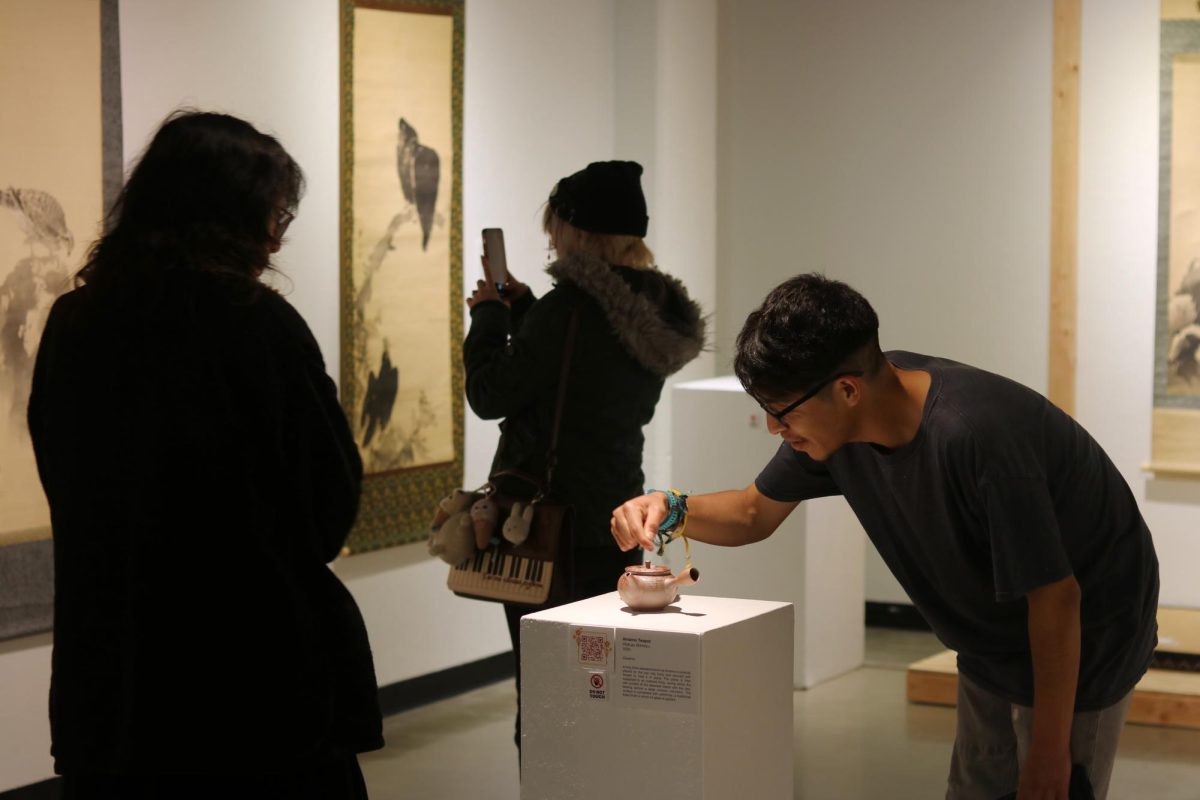
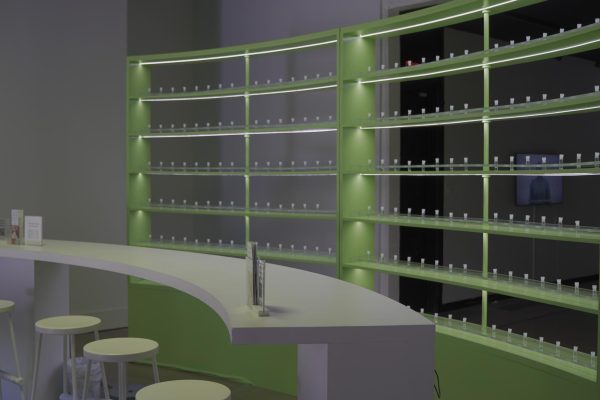
The art gallery is darkly lit with yellow-green lights overhead that impart their hue upon the stark white furniture. A projector plays a video on the wall while its audio reverberates across the walls. Displays play various videos of interviews and vague, but seemingly personal, data.
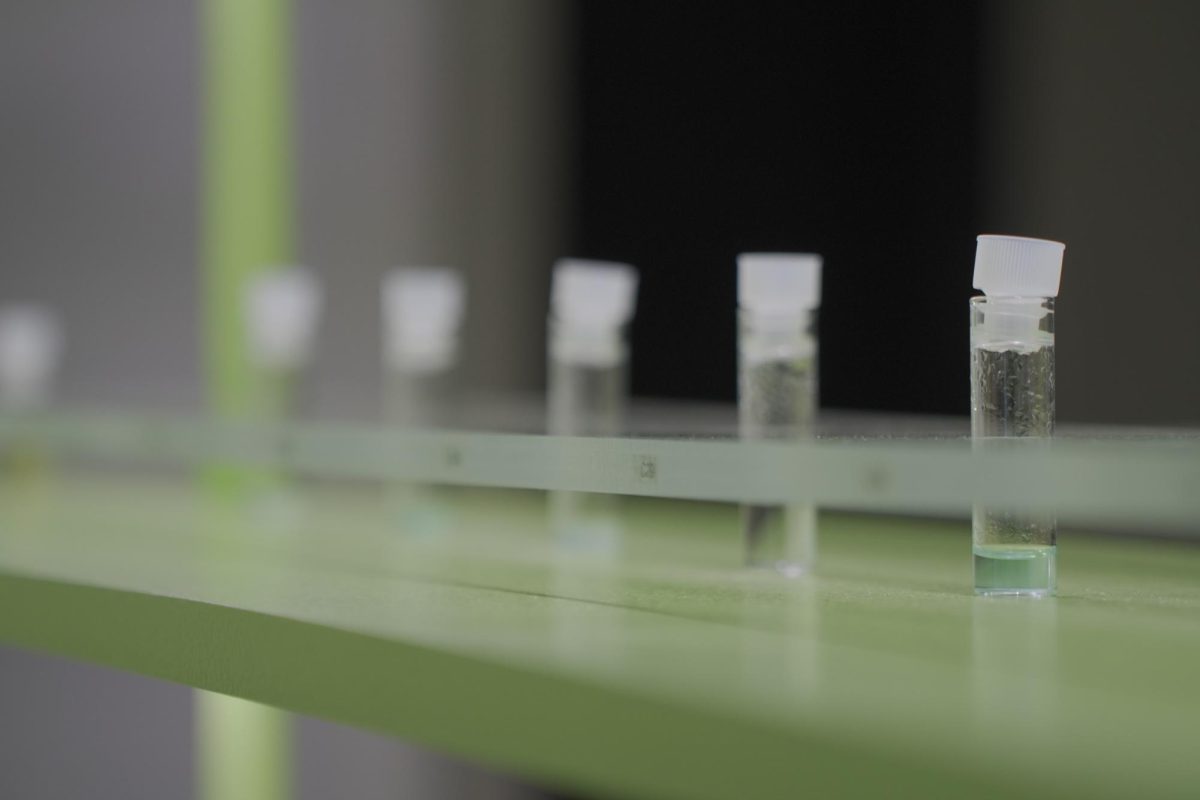
At the center of the room appears to be a bar. Behind the counter are shelves of small vials. Someone wearing a green medical mask and apron tells the student what is in the vial. The vials are filled with samples of saliva from other people, and participants are given the option to offer their own samples of saliva in exchange for one of the vials.
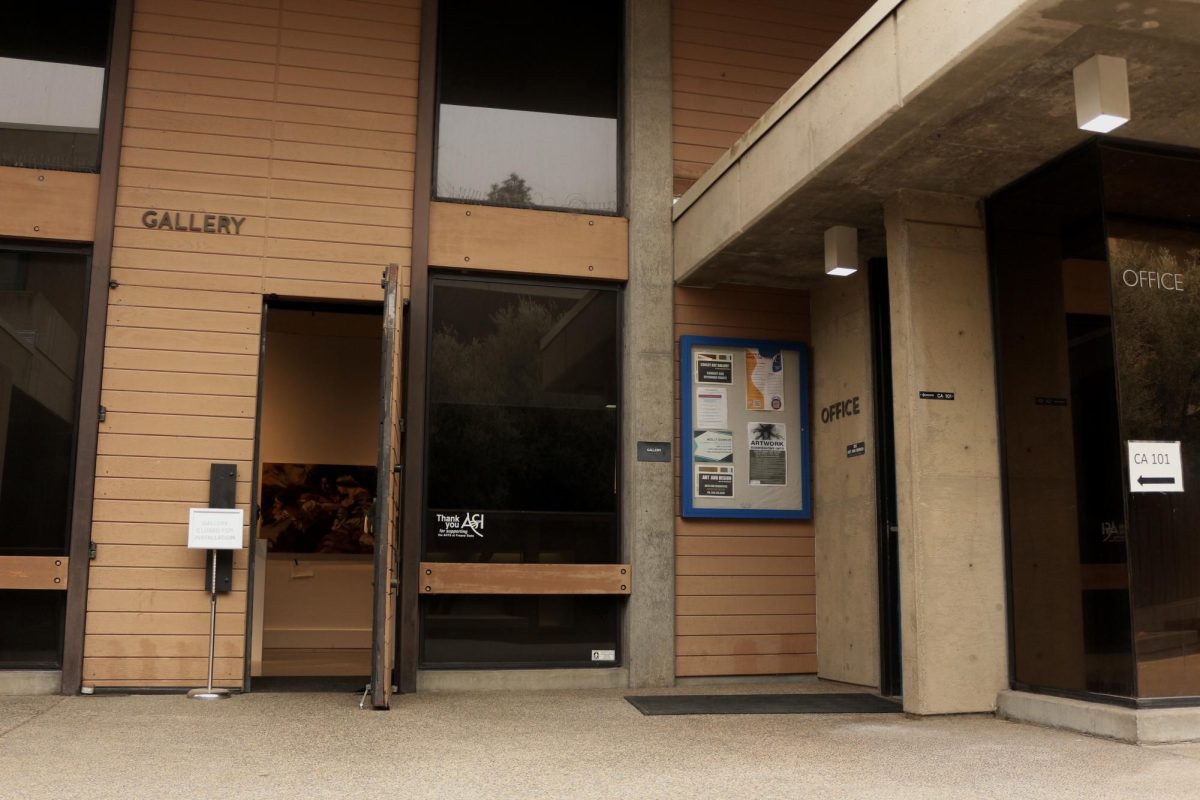
Such is the scene of Lauren Lee McCarthy’s “Bodily Autonomy” art exhibition, which is currently in its last week of display at the Phebe Conley Art Gallery at Fresno State.
The exhibition features an interactive performance featuring the Saliva Bar, where participants can offer their saliva in exchange for a vial of another person’s saliva that is displayed at the bar. The final performance of the Saliva Bar, part of the show “Saliva,” will be held 4-6 p.m. Wednesday, Sept. 24, before the exhibition officially ends after Sept. 26.
The Saliva Bar is the central piece accompanying the other exhibition in “Bodily Autonomy.” In “Surrogate,” she conceptualized an agreement for a surrogate mother to have every aspect of her life, such as eating, working out and sleeping, to be controlled by the parents.
The gallery features videos of this concept, such as a display of the biometric and activity data of the hypothetical surrogate, all of which demonstrate McCarthy’s artistic statement in “Bodily Autonomy.”
The exhibition seeks to raise questions of bodily autonomy and consent, as its Saliva Bar offers participants a chance to think about how samples of their bodies are collected. The pamphlet provided at the exhibition describes how the Saliva Bar functions as a “counter-gesture” to how people’s DNA is harvested by medical and corporate interests.
This direct and personal interaction gives a concrete feeling to the kind of exchanges of DNA that seem mundane and routine, but are often not thought about in depth.
“How many of you have hit ‘agree’ to the terms and conditions without reading it,” said Michelle Goans, a gallery technician for the exhibit at Fresno State.
The exhibition relates the anxieties of willingly giving up parts of people’s bodies without knowing how far it goes.
“We give up so much of ourselves,” she said. “We are consenting without understanding what we are consenting to.”
The Saliva Bar gives participants a chance to offer a part of themselves under their own terms and conditions. Participants can choose a vial of saliva they want in exchange, which comes with its own terms and conditions as well. Each saliva sample comes with personal details that each participant willingly gave about themselves, such as whether they are an artist or an athlete.
“Every single person has been different,” said Sarah Theller, a graduate of Fresno State with a master’s in art history, who is one of the operators for the Saliva Bar performance.
Theller explained that she engages with participants and gets them to think about what kinds of details about themselves they want with their given sample and what terms and conditions they want to leave with it.
“You really see people’s personalities come out,” Theller said.
She detailed how the exchange can be “strange and intimidating” but facilitates a sense of “tremendous trust” as participation gives them a way to express what they are willing to reveal about themselves and ask of others in exchange for a part of their body.
“It’s like a side quest,” said Sierra Cancel, a Fresno State student.
Cancel expressed how the performance was an interesting way to interact with other people indirectly and what it was like to come up with the terms and conditions.
“I think my previous sample was interesting, I wanted it mailed to France,” said Cancel. “I will be doing it a third time.”
The exhibition has drawn a variety of opinions on its message.
“I think students have found it fascinating,” said Chris Lopez, program director for the Center of Creativity and the Arts and professor of art theory at Fresno State.
Lopez explained how the inspiration to reach out to McCarthy for an exhibition of work started from a conversation with Ahran Koo, a fellow faculty member at Fresno State, about bodily autonomy two years ago. Lopez found McCarthy’s artwork intriguing and sought to get her exhibition shown at Phebe Conley this semester.
“It’s not an easy exhibition,” Lopez said. “I don’t want an easy exhibition, I want students to think and have an opinion.”
He described how timely the piece is for people living in the U.S. and how it challenges students to ponder their place in a society filled with DNA industries and surveillance.
“It brings into question: ‘what is the value of that?’” Lopez said. “Why are we just letting strangers have it?”
The Saliva Bar takes the concept of giving personal data and makes it a personal choice that makes participants aware of what they are willing to give. Some participants see the exchange and wonder about its limits.
“People really asked if we can drink the saliva,” Lopez said. “I don’t recommend it.”
Lopez feels the exhibition is a success and that he was excited to see McCarthy’s enthusiasm toward the reception she received when she came to campus to talk about it on Sept. 11.
It is a contemplative, meditative and even humorous experience that students can take and make into a statement of their personality. Whatever choices students make are up to them. However, they would be wise to follow Lopez’s advice: Don’t drink the saliva.