


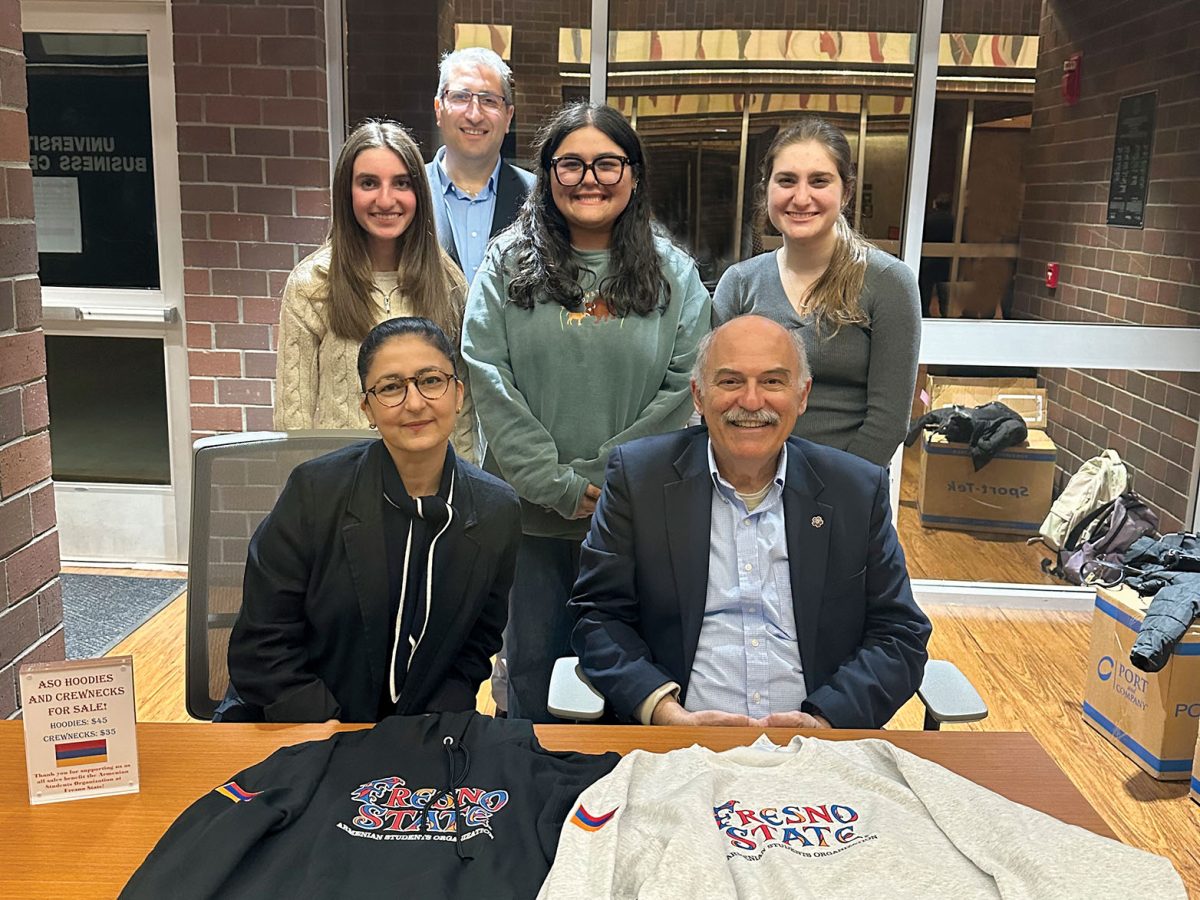
Kazan Visiting Professor Dr. Anna Aleksanyan presented a lecture on “Armenian Women’s Daily Life in Transit and Con-centration Camps (1915–1918)” at Fresno State on Friday, March 6, 2026. The lecture was co-sponsored by the Armenian Relief Society, Fresno Mayr Chapter. The presentation offered an emotional and realistic look at the harsh conditions experienced by Armenian women and children during the Armenian Genocide. Dr. Aleksanyan emphasized the psychological difficulty of studying these experiences be-cause of the extreme suffering and unjust conditions that many women and children endured while being deported and confined in transit and concentration camps.
Dr. Aleksanyan began her lecture by displaying multiple maps of Armenian provinces. These served as references to the areas discussed throughout the presentation and helped illustrate the routes taken by deportees during the second phase of the Armenian Genocide. She also categorized the exiled women into three groups based on their experiences: those settled in the eastern regions, those in the northern tent cities during 1916, and those distributed throughout Muslim villages as slaves. Out of respect for the suffering endured by these women, Dr. Aleksanyan explained that she “preferred not to show photos of the women who endured numerous hardships.” Instead, she focused on testimonies and historical analysis to convey the lived experiences of the deportees.
The lecture focused primarily on the gendered violence experienced by Armenian wo-men. The environment in the camps was heavily masculinized, contributing to the de-humanization of women and creating opportunities for men to “commit rape and other forms of sexual violence without consequence.” Perpetrators were not always the same individuals; rather, face-to-face perpetrators were constantly changing as deportees were moved from one location to another. Dr. Aleksanyan noted that “these places were designed for rest, but many Armenians died there,” emphasizing that even places meant to provide temporary relief instead became sites of death and suffering.
In addition to violence and exploitation, many women arrived at transit camps already in extremely poor physical condition, and most arrived without male family members who might have helped protect or provide for them. As a result, many Armenian women had to negotiate directly with perpetrators in order to obtain basic necessities. The situation was especially difficult because many deportees were starving and lacked adequate clothing, with some unprepared for the climate conditions. One survivor described the brutal environmental conditions, saying, “No shame was left. We baked in the hot sun during the day and froze at night. We covered our bodies in mud during the day to protect our skin against the scorching sun. The mud dried quickly and stuck to our skin. And when we tried to peel it off, patches of skin came loose, exposing raw and bleeding flesh underneath. To protect against the cold at night, we sat on the ground in circles, touching our backs for warmth.”
Despite these hardships, women frequently attempted to protect the younger members of their groups. Dr. Aleksanyan highlighted this resilience by stating, “how powerful it is to protect the children and young adults.”
Many Armenians were forced to travel repeatedly along the same routes between locations, which functioned as another form of physical and psychological abuse. An example of this was a group of deportees who were “forced to walk from Urfa to Tell-Abiad, from Tell-Abiad to Raqqa, from Raqqa to Tell-Abiad, and from Tell-Abiad back to Raqqa… which is about ninety kilometers. This was the fate of many women’s caravans, and was often done to break the will of those women who were still resisting forced marriages.”
Deportees were easily recognized and feared at each stop because of various rumors that circulated about them. As one account described, “Everyone knew that they were deportees by their looks and they were afraid, as rumors about cannibalism and other horrors had spread about the deportees.” Dr. Aleksanyan also discussed the violence and dangers that deportees constantly faced. Even reaching a city did not guarantee safety. Deportees had to “bribe guards to get into the city, and then there was the struggle of finding a room.” Even after entering a city, they lived under the constant threat of deportation.
Dr. Aleksanyan referenced a testimony from a survivor that illustrates the discrimination Armenians faced when trying to find shelter. “I was searching for a room to rent when I met an old man. He noticed that I was Armenian and advised me to search elsewhere. ‘This part of the city is not for you, you must stay away from the city.’”
Dr. Aleksanyan explained that it became “common practice” to force women into sexual slavery. In the Der Zor camp, exploitation became a method of survival for many women. Dr. Aleksanyan explained that sexual barter was common “in order to save and provide for the children. The camp guards made a good fortune by selling women and girls to anyone who would pay. These buyers were usually Arab men who would marry these women or resell them to slave owners.”
Overall, Dr. Aleksanyan’s lecture provided a deeper understanding of the daily struggles Armenian women faced as they attempted to survive starvation, exploitation, and constant displacement during the Armenian Genocide. She highlighted both the brutality of the deportation system and the resilience of the women who endured it. Her work contributes a valuable perspective to the field of genocide studies and highlights the complexities of gendered violence during the Armenian Genocide.