
The first thing I notice when I walk into a classroom isn’t the professor or the seats. It’s the exit.
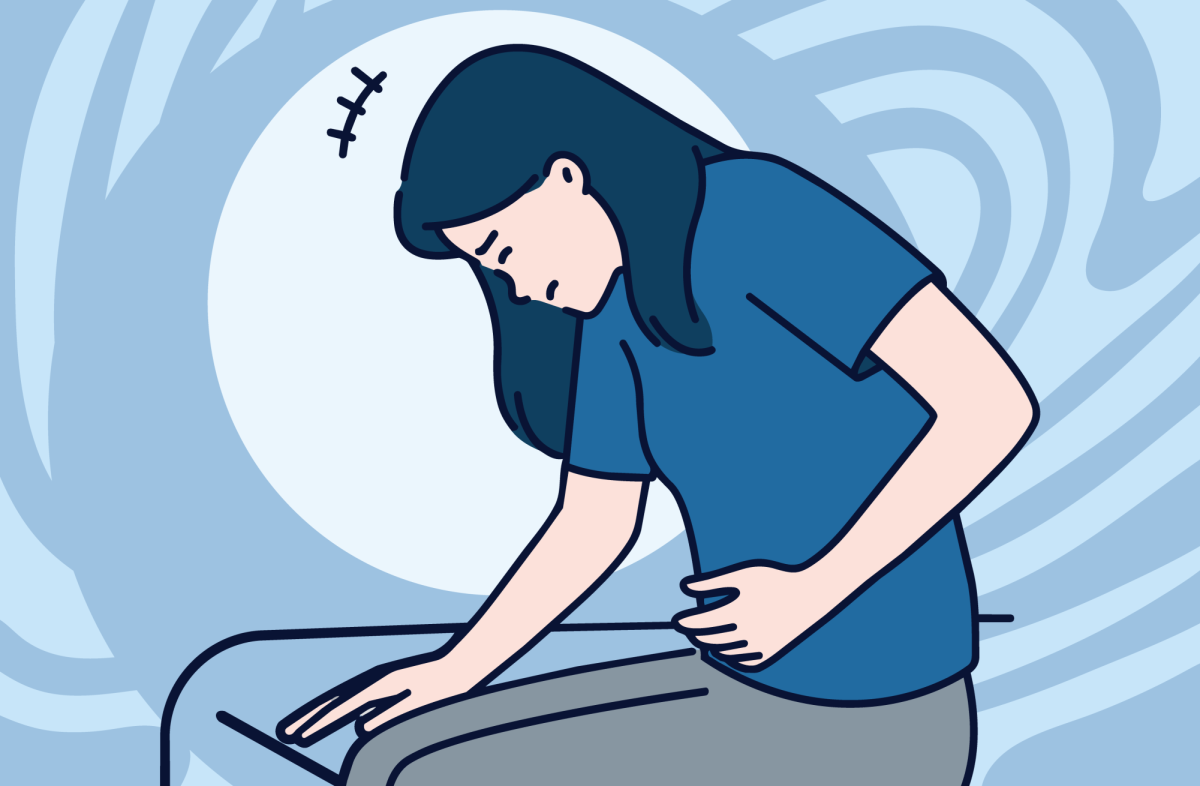
More specifically, the nearest bathroom. Living with Ulcerative Colitis means every space comes with a silent calculation: How long will I be here? What did I eat? Will today be manageable, or will my body decide otherwise?
Most students measure their college experience in credits, deadlines and late nights. I measure mine in flare-ups, energy levels and whether I can make it through a lecture without needing to leave. It’s not something you see, but it shapes quite literally everything.
Even before class begins, I find myself scanning the room without thinking about it. It’s automatic now, like muscle memory. I notice where people sit, how crowded the rows are and how long it might take to get out if I need to.
It isn’t anxiety in the traditional sense; it’s awareness. A kind of planning that runs in the background of everything else I’m trying to do.
The sound of the classroom never really fades into the background the way it’s supposed to. Even when I’m trying to focus, I’m still aware of the room in a different way than most people are. I notice who walks in late, who sits where, how close I am to the aisle, and how quickly I could leave without disrupting anything. It isn’t something I consciously decide to do anymore; it just happens.
Ulcerative colitis is a chronic inflammatory bowel disease (IBD) that causes inflammation in the digestive tract, often leading to abdominal pain, fatigue and urgent, unpredictable symptoms.
According to the Crohn’s & Colitis Foundation, about 2 to 3 million Americans are living with IBD, with many diagnoses occurring between the ages of 15 and 35, right in the middle of typical college years.
That timing matters more than it might seem. College is often framed as a period of stability-building, finding routines, balancing responsibilities, and adjusting to independence. But for students managing chronic illness, those same years can feel less like building structure and more like constantly adjusting to instability.
For many students, that timing overlaps with a period of independence and transition, when schedules become more demanding and routines less predictable. Managing a chronic illness in that environment often means adapting to situations that don’t always make room for unpredictability.
This story follows three perspectives: My own experience navigating college with the condition, my uncle, Mike Spears, who has lived with it for decades and Ethan Beck, a classmate recently diagnosed and still adjusting. Together, our experiences reflect not just the medical reality of ulcerative colitis but the emotional, social and invisible weight it carries.
The invisible weight
From the outside, I look like any other student. I show up to class. I turn in assignments. I sit through lectures. But what people don’t see is the constant awareness running in the background of everything I do.
There’s a quiet anxiety that comes with not trusting your own body.
Flare-ups don’t schedule themselves around exams or presentations. They interrupt. They take over. And when they do, everything else, like school, social life, even basic routines, just automatically comes second. It’s that baggage that comes with the diagnosis.
Some days, that awareness is louder than others. On good days, it stays in the background. On bad days, it becomes harder to ignore while trying to stay focused in class or keep up with notes. It creates a split attention, being present, but never fully settled in the moment.
There are moments when that awareness becomes harder to ignore than others. Sitting in class and trying to listen while also being aware of your own body creates a split focus. You’re present, but not fully settled. There’s always a part of you tracking what might happen next, even if nothing is happening at all.
There are days when just being on campus feels like an accomplishment, because sometimes, that is literally the most I’ve gotten myself to commit to for the day.
And then there’s the mental side. The exhaustion of explaining. Or choosing not to. The moments where it feels easier to say “I’m just tired” instead of explaining a chronic illness that people don’t always understand. It’s exhausting.
A life adjusted
For Spears, ulcerative colitis has been part of his life since he was about 20.
“It was different back then, you know,” Spears said. “People didn’t really talk about it, especially not the people I was around at 20 years old. You just dealt with it and figured it out as you went because there wasn’t any reason to pay it any mind.”
At the time, there weren’t as many conversations around chronic illness or digestive diseases, and much of what he experienced was handled privately. Understanding the condition came gradually, through experience rather than explanation.
Over time, he’s built a life around managing the condition, such as learning triggers, adjusting routines and accepting that unpredictability is part of it.
“You start to understand your body and its limits,” Spears said. “But that doesn’t mean you can always control it.”
What stands out in his experience is not just the illness itself, but how it was handled differently in another generation. The language around chronic illness has shifted over time, but the day-to-day reality of managing it still comes down to the same thing: Learning your limits without always being able to predict them.
Spears’ experience reflects something that only comes with time: Adaptation. Not perfection, not a cure, but learning how to live alongside something that doesn’t go away.
What stands out in his experience is not just the illness itself, but how it was handled differently in another generation. The language around chronic illness has shifted over time, but the day-to-day reality of managing it still comes down to the same thing: learning your limits without always being able to predict them.
The beginning of uncertainty
Beck’s diagnosis didn’t come with immediate answers.
“My diagnosis was a bit complicated,” Beck said. “When my doctor first mentioned that I might have ulcerative colitis, I didn’t know what to think.”
At the time, he didn’t fully understand what the condition meant, only that something wasn’t right.
“The only thing I knew was that there was something wrong with me and I had to live with it,” Beck said.
That uncertainty quickly turned into fear when doctors explained the potential risks. Not only would this be a new, terrifying experience, but knowing it is something that sticks with you forever, hits deep.
“My doctor then mentioned that ulcerative colitis is linked to a higher risk of colon cancer, and it did honestly scare me a bit,” Beck said. “My mind spiraled thinking about what would happen if I did get colon cancer.”
Because his symptoms weren’t typical, getting a clear diagnosis took time and multiple procedures. One can only imagine the mental toll that can take on a person. Countless appointments and tests with no real idea if or when you’ll get straight answers.
“Due to my not-so-textbook symptoms, it wasn’t until two colonoscopies and a flexible sigmoidoscopy … that I was officially diagnosed,” he said.
Now, Beck is learning what it means to live with the condition not just medically, but in his daily routine as a college student.
“My day-to-day life as a college student can have some difficulties due to my condition,” he said.
Long days on campus and commuting have made fatigue one of his biggest challenges.
“I’m now aware that this could be a reason why I have no energy at the end of the day… where I have class all day and I commute to Fresno State,” Beck said.
The exhaustion has forced him to shift how he spends his time.
“This might be the longest stretch of my life where I haven’t played any video games,” Beck said. “I’ve only had time and energy to go to school and work on my assignments.”
Even managing his healthcare has become difficult to fit into his schedule.
“With my days being so busy, I’ve struggled to find the time to look for a new gastrointestinal doctor,” he said.
The condition has also taken moments away from his personal life, taking a toll on him mentally.
“I had my flexible sigmoidoscopy the same day as my friend’s graduation,” Beck said. “I was disappointed in the circumstances that stopped me from being able to celebrate my friend’s accomplishments.”
For Beck, one of the hardest parts isn’t always the physical symptoms; it’s how invisible they are to everyone else.
“I think I’d like it if more people understood that while the symptoms of ulcerative colitis aren’t visible, they’re very real,” he said. “There’s no break from living with this.”
That reality follows him into every space, including the classroom.
“The first thing I notice when I walk into a classroom isn’t the professor or the seats,” he said. “It’s the exit. More specifically, the nearest bathroom.”
What looks like a normal college experience from the outside is, for him, a constant calculation.
“Most students measure their college experience in credits, deadlines and late nights,” Beck said. “I measure mine in flare-ups, energy levels and whether I can make it through a lecture without needing to leave.”
“It’s not something you see,” he said. “But it shapes quite literally everything.”
Listening to Beck talk about his experience, there’s a familiarity in the way he describes it. Even though he is still at the beginning of adjusting, the patterns are already forming in how he plans his days, how fatigue affects him, and how quickly his routines have shifted since diagnosis.
College, interrupted
College is supposed to be about independence and figuring out who you are, building routines and creating a life.
Even something as simple as planning a day becomes less predictable. There’s a layer of uncertainty that sits underneath everything, whether it’s going to class, meeting friends or even deciding what to eat. It’s not always dramatic, but it is constant.
But chronic illness complicates that idea.
There are small adjustments that happen without anyone noticing. Sitting patterns change. Routes across campus change. Even the timing of when you leave for class becomes something you think about differently.
Something as simple as attending a lecture becomes strategic. Where do I sit? How long is the class? Can I make it through?
Social life shifts, too. Food isn’t just food; it’s a risk. Going out isn’t always spontaneous. Plans come with conditions.
There’s also pressure. The internal push to keep up, to not fall behind, to appear “normal” even when you don’t feel it.
And sometimes, the hardest part isn’t the physical symptoms, it’s feeling like you’re living a different version of college than everyone around you.
The bigger picture
While deeply personal, these experiences are far from isolated.
IBD, including Ulcerative Colitis, affects millions of Americans, and diagnoses among young adults are rising. According to the Centers for Disease Control and Prevention, chronic illnesses like these often come with increased risks of anxiety and depression, especially among younger populations balancing school, work and health.
For many students, that impact is not always visible on the outside. Internally, though, it can affect focus, attendance, energy and long-term academic planning.
The unpredictability of the disease doesn’t just impact the body. It affects academic performance, social interaction and overall quality of life.
Yet because it’s largely invisible, it’s often misunderstood.
Living with Ulcerative Colitis in college means learning to exist in uncertainty.
It means redefining strength not as pushing through everything, but knowing when to slow down. When to adapt. When to give yourself grace.
It means finding connection in people who understand, like Spears, who has lived this reality for decades, or Beck, who is just beginning to.
And it means recognizing that resilience doesn’t always look the way we expect.
Sometimes, it’s not big or visible. Sometimes, resilience is sitting in a classroom, quietly mapping out the nearest exit and choosing to stay anyway.