


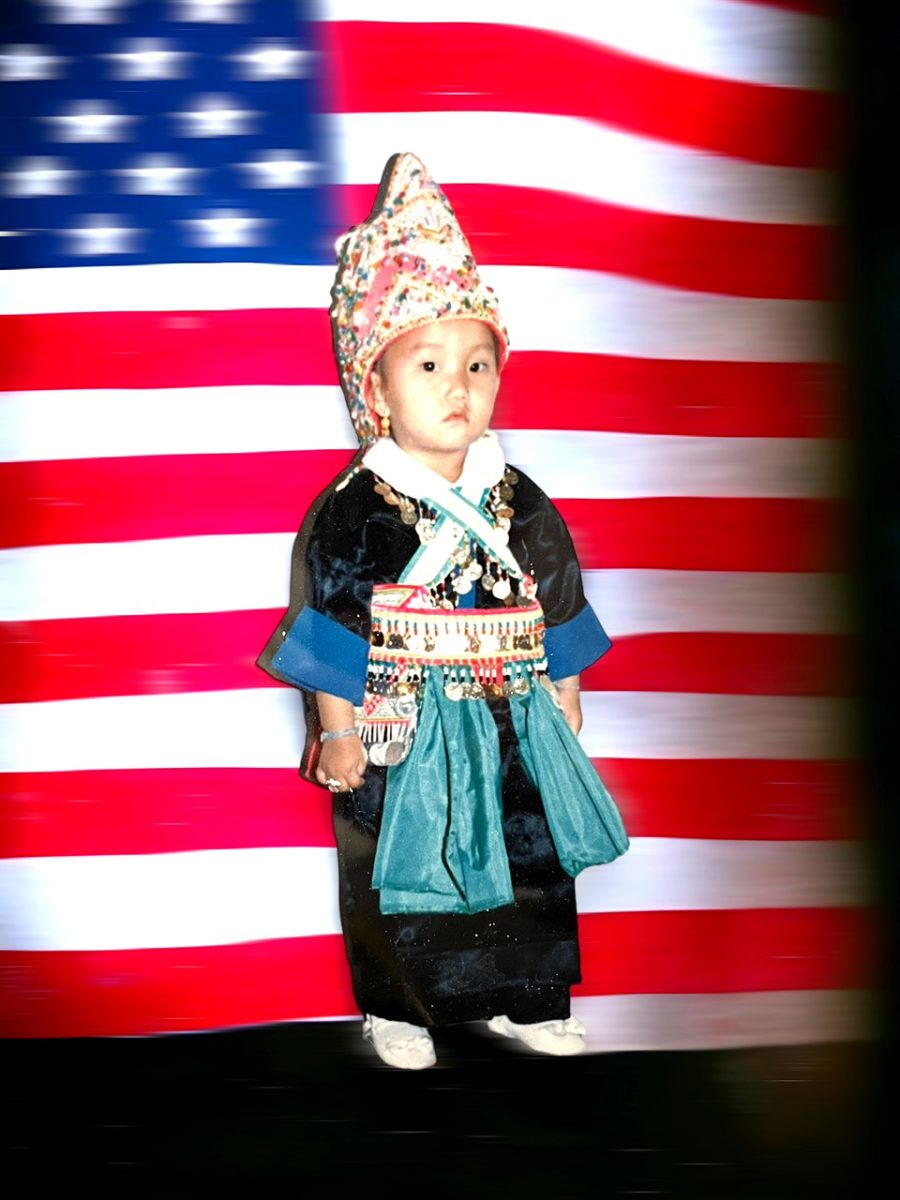
Three years ago, California rejected a bill that would have banned child marriage. Today, Kate Yang, a former Fresno resident, Hmong activist and child-marriage survivor, is determined to change that.
Child marriage is legal in 34 states, four of which have no minimum age to get married. These states include Oklahoma, Mississippi, New Mexico and California.
At 12-years-old, Yang became a victim of child marriage at the hands of her own family. Without any laws protecting her, Yang dealt with mental, physical and sexual abuse.
Yang’s story
Yang was only three when her family left Ban Vinai, a refugee camp in Thailand which held up to 45,000 people, and moved to Fresno. Like many Hmong refugees, Yang’s family lived in uncertainty with little privacy, safety and freedom.
“You learned to follow rules and stay invisible to stay safe,” Yang said.
Many Hmong people lived in the mountains of Laos. During the Vietnam war, the U.S government signed a treaty ensuring there will be no U.S. military activity in Vietnam or surrounding countries, like Laos. The CIA later approached Hmong village chiefs and appointed General Vang Pao to choose generals and recruit soldiers to fight against the Communist regime in North Vietnam. After the secret war ended, the generals were granted places to live in the U.S.
Yang shared that her mother and her family had to flee their home in Laos to the refugee camp in Thailand due to the war.
Carrying the weight of war, Yang’s family landed in public housing in Fresno, where she attended Jefferson Elementary School and later Martin Luther King Elementary within Fresno Unified School District.
Though she still faced language barriers and cultural gaps, school became the only place of normalcy, a place where Yang could be a child, although she still faced language barriers and cultural gaps.
“I stood out at school, and I didn’t have the words to explain where I came from or what I had already lived through,” Yang said. “I was physically in America, but mentally still in survival mode.”
Shortly after Yang and her family arrived in the United States, her father abandoned his family because he wanted sons rather than daughters. Yang’s mother, pregnant with her third daughter, was left homeless and later placed into public housing.
Yang dealt with an overwhelming feeling of sadness seeing her mother dealing with these circumstances and struggling to speak English.
During this period, Yang’s mother took her family to the local church where they received donated clothes.
“Most of my clothes at the time were handmade by my mom to save money, and this dress felt different,” Yang said. “Wearing it made me feel American. It made me feel like I fit in. “It reminded me that dignity and belonging can come from the simplest acts of kindness.”
From California to Washington
At 11-years-old, Yang returned home from school to find her belongings packed into a pickup truck. She was told she would move to Washington to live with her aunt and uncle and help care for their five children.
Yang said the absence of a man in her household created a sense of “hopelessness” due to cultural expectations. Families are not able to practice traditional ceremonies without a male in the household. Yang’s mother relied on extended family such as her brother during her divorce. So, when her sister-in-law came asking for help, it was hard to refuse.
“If she [Yang’s mom] said no, how would my uncle respond? Because that’s his wife who was the one who needed my mom’s support,” Yang said.
In Washington, Yang lived in a two-bedroom apartment with her aunt, uncle and cousins. Her aunt and uncle enrolled her in school. Yang said she was shocked that faculty did not double-check her circumstances.
Married at twelve years old
Yang’s aunt was active in the Hmong community, where traditional ceremonies often included cooking, cleaning and animal preparation tasks assigned to girls.
“Someone needed to help kill the chicken, pluck the chicken, gut the chicken, cook the chicken, make the steamed rice. I can do all of that, I was raised in that kind of environment,” Yang said.
It was at one of these ceremonies that Yang’s former Hmong husband saw her. He came from a well-respected family as he was a grandson of a Hmong general from the Secret War.
In an article by Kao-Ly Yang, a Hmong studies anthropologist, she said that bride price (nqe tshoob) is an “indispensable and foundational” part of marriage.
For Hmong women, a marriage is a “spiritual and physical departure from her natal family to join her husband’s lineage.” Kao-Ly Yang continued, “This transition historically involved the loss of her first name, clan surname, lineage affiliation, the right to die in her parents’ home and, in conservative households, autonomy over major life decisions such as education or employment.”
Marriage serves as a social exchange that aims to resolve social relations and reinforce social norms. Yang was forced to take part in traditional ceremonies, including one in which the bride is kidnapped (zij poj niam).
“What’s important to understand is that this wasn’t culture as identity, it was culture being used to justify removing a child’s autonomy and safety,” Yang said.
“Assigning a price to a bride signifies attributing value to the alliance and sealing a lifetime contract between two lineages,” Kao-Ly Yang wrote.
For $6,000 USD, Kate Yang’s sovereignty was sold. At age 12, she was wedded to a 19 year old.
On her first day of school, Yang’s mother-in-law told her not to tell anyone about the marriage. She threatened that the police would arrest her mother and child protective services would take her sisters.
“That threat created intense fear and kept me silent,” Yang said.
Yang said that going to school while being married was like living two different lives. At school, she was expected to act like a student, do homework and interact with peers. But at home, she was expected to take on adult responsibilities like being a wife, a nanny to her husband’s sibling and eventually become a mother at age 15.
Her former husband was abusive, both physically and mentally, making her home unsafe.
“I spent much of my energy trying to avoid conflict and manage fear rather than focusing on learning or growing the way a child should,” Yang said.
A couple of months after her marriage, Yang visited her aunt and uncle. In a moment alone with her aunt, she cried as she told her that her husband was physically abusive. Expecting an adult to help her, her aunt told her she was ‘damaged goods’ and there could be ‘no refund.’
Yang was told she would bring shame to the family and the Hmong community would reject her if she were to leave her marriage. Later, her aunt brought Yang’s former husband in and told him not to beat her. Once she returned to Washington, her husband beat her again and threatened to kill her if she told anyone.
“That was the moment, at 12-years-old, when I realized help was not coming. At the time, I didn’t understand it as a legal failure; only later did I realize the system recognized the marriage but not the child inside it,” Yang said.
During that time, child marriage was still legal in Washington. It allowed minors to be married. According to Yang, the system saw her as a wife before a child.
“The impact wasn’t abstract, the absence of that bill directly shaped my childhood,” Yang said. “If the law had clearly prohibited child marriage, the adults involved would not have had the same power over my life, and I would have had a path to safety.”
Two years later, she suffered a miscarriage due to physical abuse by her former husband. Enduring the pain of being in labor for 21 hours, Yang gave birth to her first child at age 15. At age 17, Yang gave birth to her second child.
Yang’s reproductive and healthcare rights were violated by her former husband and he refused to allow Yang to take pain medication during childbirth.
“At one point, the abuse was so bad that the thought of ending my life felt like it could be freedom,“ Yang said in testimony in support of the Colorado bill to ban child marriage. “I realized that at that moment that help was not coming. That I needed to find the courage to save myself. I have to at least try to do it for my children.”
At age 23, Yang escaped her marriage.
She attended the University of Washington where she was exposed to different resources outside of the space she was confined to. Yang learned about consent and rights, realizing that the life she lived was not acceptable. She earned a degree in biology and later in business.
In 2023, Yang started her advocacy work in banning child marriages. A year later, working with non-profits such as Unchained At last, she successfully helped to ban child marriage in the state of Washington.
Yang shared her experience with lobbying in Washington, in which she met with community leaders, educators and advocacy groups to share how the law really affected families.
Mental pressure of advocacy
Advocating requires transparency of one’s personal experience. Yang shared how difficult it is to explain something so self-evident.
“There’s a strange feeling when your childhood is treated as an abstract scenario,” Yang said.“I try to remember the debate isn’t about questioning my life, it’s about how systems decide what protections should exist. Keeping that perspective helps me stay steady.”
Advocacy takes a toll on its participants. For Yang, it required her to revisit parts of herself she tried to leave behind. Yang is battling with complex post-traumatic stress disorder due to long-term trauma.
“I continue because the cost of speaking is still smaller than the cost of silence would be for the next child,” Yang said.
Yang said that structured emotional support and spaces to process advocacy work privately can be beneficial to advocates.
“People often see advocacy as strength, but it also requires care,” Yang said.
Bills that Could Protect Children in the U.S
There were efforts to ban child marriage in 2017 by Senator Jerry Hill, however they were blocked by organizations such as the American Civil Liberties Union, the Children’s Law Center and Planned Parenthood. This bill aimed to set a minimum age of 18 for marriage.
In 2023, Yang, along with a non-profit, Unchained At Last, lobbied to get child marriage banned with a clear minimum age of 18 as well. As of now, if a minor is married, they might not be able to sign contracts, file for divorce independently or seek protection as they are still a minor, leaving them completely stuck.
According to Yang, this bill will keep child protection laws consistent, ensuring that adulthood and other responsibilities that come with marriage begin when a person has the legal capacity to make that decision.
“The bill doesn’t interfere with culture or relationships; it simply sets a boundary that childhood cannot be legally signed away. That boundary can prevent years of harm before it begins,” Yang said.
In Spring of 2024, Yang went to Sacramento to support Assembly Bill 2924 (2024) in California to end child marriage. The bill was ultimately blocked by Assemblymember Ash Kalra. The bill was also opposed by ACLU (American Civil Liberties Union) California Action who believed this will “unnecessarily and unduly intrude[s] on the fundamental right of marriage.” Planned Parenthood also opposed the bill as they believe the strict minimum age of 18 without expectations could “hinder a minor’s ability to access reproductive care.” As of now, child marriage is still legal in California with no minimum age.
Yang believes that the current system protects the status of marriage more than the minor within it. The ones left behind are the isolated minors without resources or people who advocate for them.
Yang’s call to action
Yang remarried. She still lives in Washington with her husband, where they started a mixed martial arts gym called Bonafide Boxing. There, Yang is a project manager handling the administrative side. She shares a special bond with her pet, Winnie Yang.
Yang urges readers to start conversations, to learn and support policies that keep protection laws consistent and create a space where young people feel safe.
“Change begins locally, awareness and compassion at the community level make laws more meaningful,” Yang said.
For her, success means that childhood cannot be signed away.
Yang shared a message to child brides:
“What is happening to you is not your fault, and needing safety does not mean you are betraying anyone. There are people who will believe you and help you.”
Correction: This story was adjusted on May 8 at 12:41 p.m. to correct the spelling of General Vang Pao’s name.





Ron and Roberta Genini • May 6, 2026 at 4:21 pm
California law does not permit, except in RARE circumstances, marriage under age 18. Your story, while sad, is less than credible. Any search of California law will show this.
Kay lee • May 6, 2026 at 4:05 pm
I’m glad some one is out there fighting for this. I was not abused and my relationship with my husband isn’t too bad, but I was 15 when I got married culturally. I was pregnant and had to, but that was not what I wanted. If I refused to get married, I would have shunned and shamed(according to my mom.) If I knew now what I knew then and if I had more courage to stand up for myself I would not have gotten married at 15. Just like this story I played a few different roles. I was a student at school and a wife, daughter in law, and mom at home. It was hard having to hid my life. I feel like that time traumatized me and now that I am 40 I am just now learning to find myself again and get over it. I am still with the one I married to this day, but if I can go back I would not have gotten married.