


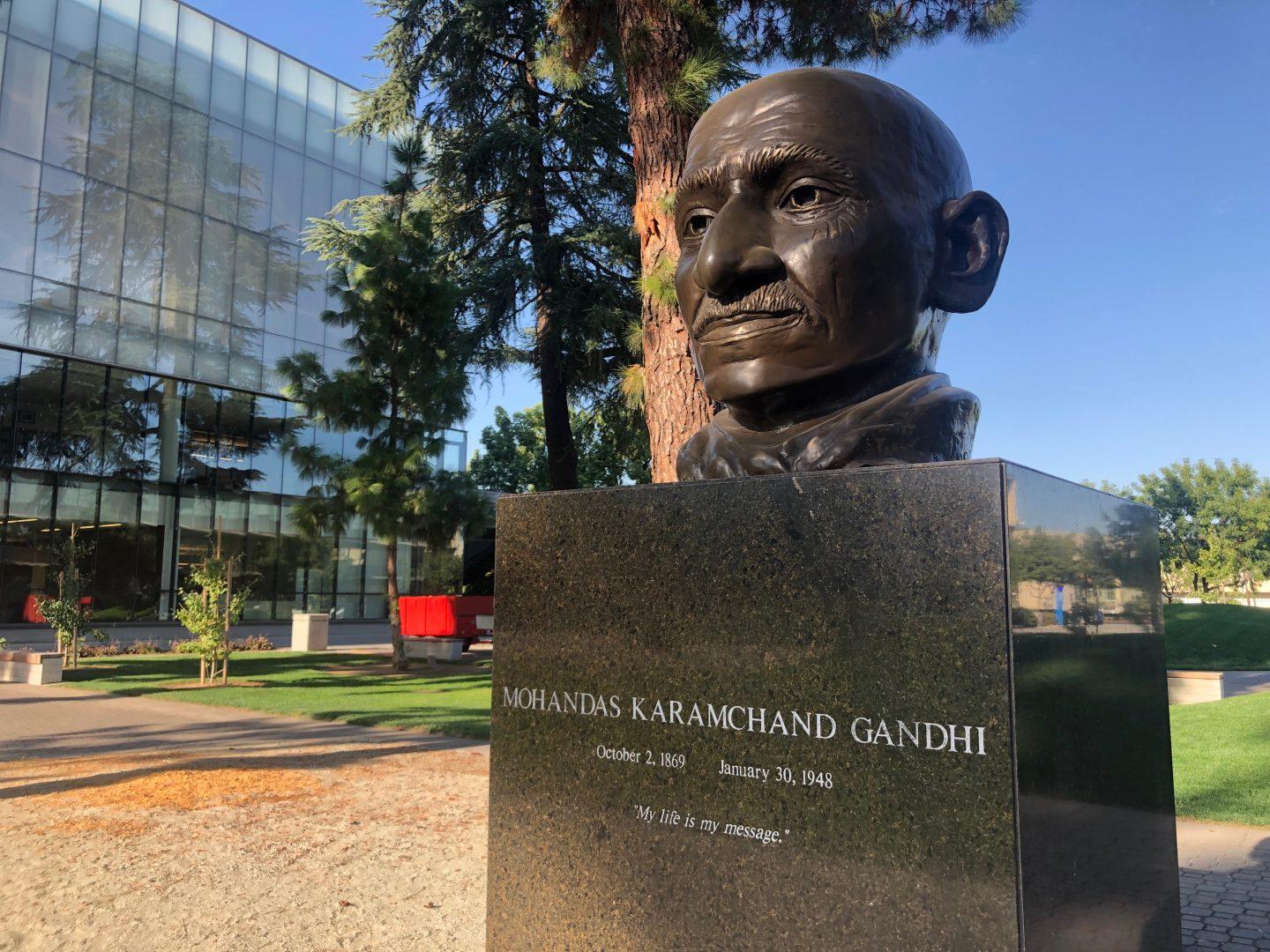
After sexual assault allegations against César Chávez arose last month and his statue was promptly removed from the Fresno State Peace Garden, the long-time discussion about the Mahatma Gandhi statue has come into light.
For years, community members have been pushing for Gandhi’s statue to be removed, for reasons including, but not necessarily limited to, the following:
While in South Africa, Gandhi wrote that white people should be the dominant race in the region.
Gandhi wrote that black people “are troublesome, very dirty and live like animals.”
In order to test his chastity, Gandhi slept naked next to his grandniece when he was in his late 70s, and she was in her late teens.
People will likely disagree that Gandhi’s transgressions equal those of someone like Chávez. But there’s one main, aching difference: That the university’s reactions to the controversy surrounding Gandhi’s past and Chávez’s are wildly different.
The university, immediately after hearing of Chávez’s wrongdoings, issued public statements and advocated for survivors of sexual abuse.
They covered up his statue and, in a campus-wide email sent out on March 20, reassured the community that Fresno State has “a responsibility to respond with moral clarity when faced with allegations of this nature.”
But what moral clarity is the university referring to?
In Gandhi’s case, even after years of students expressing their anger and disdain toward him, the Gandhi statue remains in the Peace Garden, and there are no current plans for its removal. In fact, Gandhi’s inaugural statue was what began the Peace Garden altogether.
This difference raises a few primary, philosophical questions:
Where do we draw the line on a leader’s morality — and at what point should we consider them morally reprehensible and unworthy of public praise?
When examining a leader’s character and moral high ground, what is the difference between actions and statements? Does one warrant more forgiveness than the other?
These questions began eating at me, like little termites that eventually became unavoidable, so I reached out to someone who has studied Gandhi extensively.
Veena Howard, director of the M.K. Gandhi Peace Center and Gandhi scholar, weighed in on Gandhi’s presence in the Peace Garden and where she believes his true morality stands.
She said that one big difference between the two situations is that Gandhi’s past has been debated and analyzed for decades, and Chávez’s was just recently revealed.
“That’s a big difference,” Howard said. “Gandhi’s life has been no bedrooms, no curtains, no behind the desk.”
She said that there has been no other person in the 20th century who tried to live morally in every aspect of life, which distinguishes Gandhi from other leaders.
“All humans are imperfect, and Gandhi highlighted his flaws and failings in his autobiography and his other writings,” Howard said. “Gandhi tried to live a life of moral principles — sometimes to very extreme [measures] that people around him and his family had to endure hardships.”
This brings into question what constitutes morality. If someone simply tries, even with all their might and fails, to uphold the strongest-perceived standards of morality, is that the final golden ticket, even if it comes at the detriment of others?
If achieving peace and non-violence took the sacrifice of various communities and his peers, can we really view the outcome as if it’s clean?
And more, should we look past a leader’s moral failures that, whether we like it or not, stand side-by-side with their achievements?
Howard said that Gandhi believed that violence is not limited to the physical.
“He took nonviolence very, very broad,” Howard said. “He didn’t say that nonviolence is not harming someone — if I am not giving you proper wages, then I’m being violent. So for that reason, he adopted stark simplicity.”
If violence is not limited to physical actions, then we can attribute his harmful words as direct examples of violence. And in this case, his image worsens.
Howard also said she views Gandhi and his statue more as an idea of the positive principles he pushed than as a man.
Nonviolence, simplicity and stoicism are all admirable qualities that we should strive to emulate, and reminders of these traits are vital to this journey.
However, the Gandhi statue is not an idea. It is a large sculpture of his head and was made directly in honor of him. Therefore, we must also examine who Gandhi was as a person, because he is our literal, personified example of these qualities in the Peace Garden.
Gandhi “ought not to.”
Scholars and philosophers have debated the concept of human morality and how it’s determined for centuries.
C.S. Lewis, in his book “The Problem of Pain,” partially characterizes morality into two phrases: The feeling that we “ought to” or “ought not to.”
He argues that moral law is subjective to the individual, but that the inexplicable sensation of condemnation when we commit morally questionable acts can be attributed to God, from the frame of Christianity.
However, even non-Christians — atheists, for example — still experience some sort of reproach and guilt that forms their moral compass. Even without a foundation, humans are complex beings whose lived experiences and intrinsic beliefs still produce a sense of “ought to” and “ought not to.”
Our ability to understand and forgive morally reprehensible actions also comes from these societally set doctrines, shared and unshared, set and unset, niche and large.
Applying Lewis’ philosophy to modern disputes, such as the cases of Chávez and Gandhi, we can reasonably conclude that they “ought not to” have said and done many of the things that they did.
And I find it intensely difficult to believe that they felt no remorse while taking the actions that today are receiving so much scrutiny.
But then comes the idea of growth and forgiveness, in Gandhi’s case.
“As a scholar, when I study his life, I witness an evolution of his ideas,” Howard said. “He learns from mistakes. Some of his ideas and ideals, nonetheless, have been severely critiqued and debated by scholars.”
Howard referred to his patriarchal views and early opinion that the Indian race is superior, views that she said changed as he grew in his movement.
A person’s upbringing has much to do with how they function in society, which may have played a role in Gandhi’s excuse for his racist statements. However, if we go back to Lewis, we can draw the conclusion that some aspects of our moral compass are inherently something we feel.
So if Gandhi eventually came to more developed conclusions on women and racism, I suggest that these beliefs were already within him, somewhere. Thus, when making these offensive statements, Gandhi may have thought that he “ought not to,” yet he still said them. And they remain as sources of anger for certain communities to this day.
And we cannot forget that when modern leaders and celebrities are exposed for having said or done something politically incorrect, we typically do not say, “Oh, but they were raised in x,y or z scenarios.”
We say that what they did was inexcusable and usually end up canceling them.
So again, what is the real difference here? Why one, and not the other? How can one leader’s legacy be completely erased from public recognition, while another’s lives proudly on? Where is the line?
If the true difference between Chávez and Gandhi’s cases is that one’s actions were studied for years and another’s were judged immediately, that’s quite a flimsy, inconsistent system and one that I question on all fronts.
Advocating for the removal of the Gandhi statue is not something new, and it is only part of my point.
I ask the university and the general public to focus their attention on the very principles of consistency. We cannot condemn one and not another without a clear line of reason being drawn, and with the way I see our Peace Garden, that line has been shot to hell.






Michael Onyebuchi Eze • Apr 14, 2026 at 5:30 pm
Thank you for this thoughtful piece, which I read with great interest. One truth we too often ignore is that heroes are rarely perfect; indeed, the very demand for perfection may itself enact a kind of rhetorical violence.
In Gandhi’s case, many allegations—particularly those concerning racism—must be approached with historical care. Some of these claims are anecdotal, while others are inseparable from the political context of British imperial rule in India. Following the Punjab massacre, and as Gandhi increasingly became the moral and political center of anti-colonial resistance, imperial propaganda had strong motives to weaken his authority and tarnish his image.
Yet the deeper point remains: Gandhi, like all heroes, was imperfect—and perhaps that is precisely as it should be. Heroes do not endure in history because they are flawless, but because they reflect, in heightened form, the fragility and contradiction of the human condition.
After all, few Western philosophers expressed racist views about Black people as explicitly as Hume, Kant, Hegel, and Montesquieu. Kant even went so far as to deny Black people full standing within humanity. And yet, as a historian of ideas, I cannot imagine my intellectual formation without Hegel, and especially without Kant. That is why one must resist the easy impulse to throw away the baby with the bathwater.
History is not a realm of innocence. Today’s villains may become tomorrow’s victims, and today’s victims tomorrow’s villains. What matters, then, is what we learn from our shared human brokenness, and how we transform that awareness into a more hospitable world—one in which every imperfect being may still find a home.
That is all!
— Michael Onyebuchi Eze (Africana Studies, CSU, Fresno)