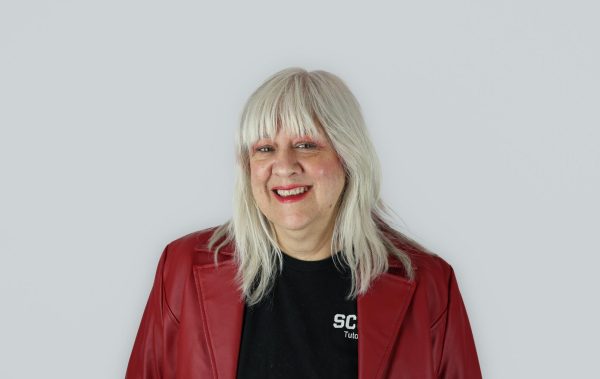

The Central Valley California Arts Project offers a two-day workshop for local art teachers with Hyeyong Maeng, assistant professor of art, design and art history at Fresno State.
The event is organized by the Kremen School of Education and Human Development and will be held on Nov. 7 and 8, in the Phebe Conley Art Building at Fresno State.
“I think it is important to deliver AI and art workshops for local art teachers to inform and keep them up to date,” Maeng said.
Maeng said that since the passing of Measure P, Fresno has provided grants to help hire local art teachers. She said this was a great opportunity for her students to get jobs and teach in the area.
“I started incorporating AI-generated images in my painting in 2020,” Maeng said. “First, I used a photo transfer technique.”
A photo transfer technique involves transferring an image from a printed surface onto another material such as paper, canvas or wood. She said that this was a standard technique for students and teachers.
Maeng said that sometimes students have a creative block and can’t visualize, but with artificial intelligence (AI), students can write a prompt that generates an image. She said the image generator isn’t perfect, and it may have to be run several times to get the ideal outcome.
“50% of students struggle with observational and representational techniques,” Maeng said. “I want to let them know it’s okay, and that they can still produce meaningful art.”
She said that when it comes to AI literacy in the art world, people should not let AI take the lead; they need to be in control. The AI lacks a sense of responsibility and can be biased. She added that the artist is accountable for accuracy and responsible for the content.
“Transparency is key,” Maeng said. “If you use AI, you should indicate that you have used it.”
Maeng said that Refik Anadol is one of the most prominent AI artists today. Anadol is a Turkish American media artist and designer who pioneered the aesthetics of data and machine intelligence. His body of work locates creativity at the intersection of humans and machines.
She said that educators need to prepare their students for the future, and that some faculty dread having to compete with AI.
“It is our responsibility to get students ready for their AI hereafter,” Maeng said. “It will be difficult for them to get jobs after graduation if we don’t.”
More information can be found here.