
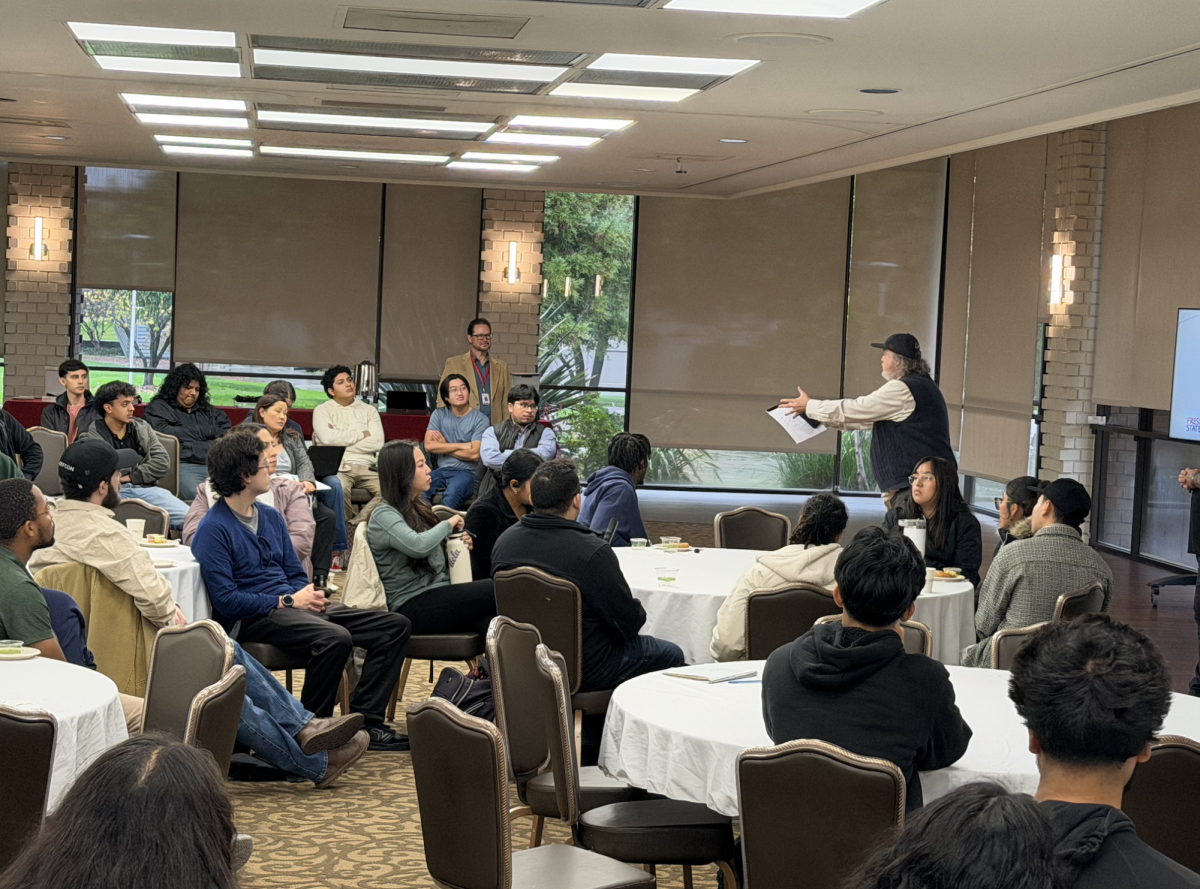
The Central San Joaquin Valley Cybersecurity Consortium (CSJVCC) held its end-of-year breakfast, followed by speakers and an Information Technology (IT), Cybersecurity and Artificial Intelligence (AI) Careers Employer Panel at Fresno State on Nov. 17.
The event, which focused on the future of AI in cybersecurity and its impact on career opportunities, was held at the University Dining Hall in the east banquet room.
CSJVCC was created with a cooperative mindset during a collaborative project between Fresno State and Fresno City College (FCC). The consortium brings together a wide range of partners, including educators, administrators, industry professionals, business, law enforcement and government agencies.
It aims to strengthen cybersecurity education, workforce development and regional community resilience.
Verne Farley, the cybersecurity instructor at FCC, said that Timothy Woods, dean of business education at FCC, and Keith Clement, a criminology professor at Fresno State, wrote a grant aiming to connect minority communities with education and job opportunities in the IT and cybersecurity industries.
One outcome of the grant was the establishment of the consortium.
“The idea is to get schools, local businesses, local technology and government agencies altogether talking about cyber and AI,” Farley said. “That’s our one goal.”
He said that Fresno State and FCC are coordinating courses, workshops and combining students, faculty and administrators from both campuses.
“It’s just been a really good experience,” Farley said.
Fresno State is piloting a program in partnership with California State University, San Bernardino and San Jose State to address a critical shortage of cybersecurity professionals throughout California and the United States, according to The Business Journal.
The purpose of the pilot program is to develop an innovative collaboration with key stakeholders and major partners to promote cybersecurity and emerging technology career education pipelines and pathways, thereby creating a skilled workforce.
A recent change in the California Education Code, via Assembly Bill 569, allocated $1 million to Fresno State and San Jose State for the program, with San Bernardino receiving $2 million.
Woods said that the grant work showed him, Clement, and Farley that the cybersecurity industry lacked a way to connect vendors, students and professionals.
“We do quarterly meetings between Fresno City and Fresno State,” Woods said. “As educational institutions, we’re trying to be the ones that are bringing the industry to the workforce.”
Woods said that cybersecurity was a central area for jobs because organizations that don’t understand AI are deeply concerned about security implications and fear that investing in AI will make them more exposed.
He said that if technology is implemented and vulnerabilities are understood, protections can’t be put in place.
“I’m seeing more opportunity for Fresno State students,” Woods said. “The modern knowledge worker is gonna have to understand artificial intelligence.”
Clement said that 60% of the attendees at the event were students, and the other third were industry professionals and community stakeholders. He said he just filled out a $710 million congressional authorization for Fresno State to develop a cyber campus.
The plan is to expand a soft start campus in IT cybersecurity education and to collaborate with FCC on workforce development, offering students cybersecurity graduate and undergraduate courses at Fresno State.
“There’s a lot of things going on at Fresno State in the cyber world, and it’s super exciting,” Clement said.
Clement said they had attendees from Merced, Fowler, Reedley and Sanger, and that the San Joaquin Valley cyberconsortium was growing.
“The students show up because they meet industry people, and the industry people show up for the career fairs to hire students,” Farley said.