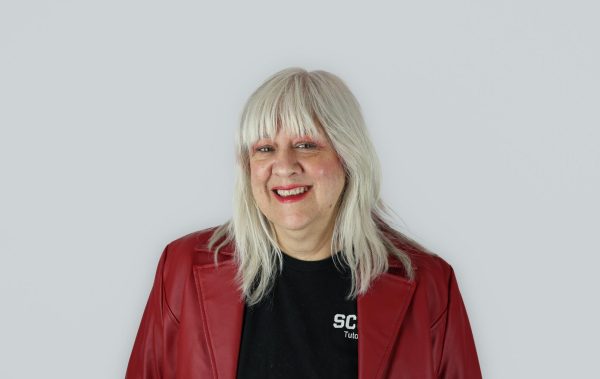


Davian Thompson is a 52-year-old Fresno State theater arts graduate who never got to attend her high school prom.
“Back in the ‘80s, when I had my prom, my grandmother was sick and in the hospital, and I missed going,” she said.
So, she jumped at the chance to attend Fresno State’s Second Chance Prom, an event geared toward students who didn’t get the opportunity in high school the first time around.
But, once she was there, Thompson said that people kept saying they didn’t know the “staff” was invited.
For older students at Fresno State, daily life often includes being mistaken for professors or custodians.
According to the Education Data Initiative, in 2024, 2.18% of college and graduate school students were over 50. For some, ageism is part of the college experience, while others don’t have any issues.
Summer Miller is a 45-year-old junior majoring in advertising and public relations at Fresno State. She stated that she first began college at 18 and recalled that there were older students back then, and she expected to see at least one person who was not in their 20s.
“I felt a little weird at the beginning of the semester,” Miller said. “It was more about how I was feeling, and not ageism directed towards me.”
Now, she has no problem with younger students and doesn’t feel any awkwardness or judgment for being older.
In contrast, Thompson said that she experienced ageism at Fresno State while attending the Second Chance Prom, which Young Life hosted.
Young Life is a Christian ministry that reaches out to middle school, high school and college students. Young Life has a presence on over 230 campuses across the nation.

She explained that, toward the end of the night, after taking a picture with her date under the big balloons, Ben Boulter, the college director of Young Life, approached them and questioned why they were there and how they found out about the event. He asked Thompson to show him her student ID and clarified that the Second Chance Prom was geared toward younger students, aged 18 to 22.
“Are you being ageist?” Thompson asked.
Ben Boulter responded to Thompson’s concerns by stating that his primary responsibility at Young Life events is student safety. He explained that he must meet with anyone they do not recognize, welcome them to the event and verify their student status.
Boulter said Thompson and her date were the only attendees over 30, apart from the DJ and the alumni volunteers, but that was not the reason behind his initial check-in and request for their student status. He said that once they were confirmed as students with tickets, he welcomed them to the event, and they stayed the whole time, seeming to enjoy their Second Chance Prom.
“I did this privately with them, not in front of the other students, to avoid unintentionally embarrassing or singling them out,” Boulter said.
Thompson reiterated that Boulter did not verify their student status until the end of the event, and carding them was not a welcoming check-in at the beginning of the prom.
The Age Discrimination Act of 1975 prohibits public and private universities that receive federal financial funds from discriminating against a person based on age in programs, services, activities, and student clubs.
The Collegian contacted Boulter, informing him that Thompson had provided a different timeline in the evening when he verified her student status and inquired if he would like to respond. Boulter did not comment.
“He made me feel that I wasn’t welcome to be there because I was too old,” Thompson said.
Regarding ageism, Miller stated that if anyone judges her for being older, that’s their problem. She said that she is not going to listen to that noise. Miller explained that most people nowadays have degrees, and now that she is more mature, she can do it.
“Better late than never is my motto,” Miller said.
Amr Mostafa is a 61-year-old graduate with a bachelor’s degree in social work. He said that the opposite of ageism has happened to him, and he has never experienced ageism at Fresno State.
Mostafa completed high school in 1979. Before returning to college, he owned a security business until he became disabled due to arthritis.
Mostafa expressed that he felt frustrated and depressed, which led him to start drinking. While his wife was working, he found himself unemployed. Then, a friend reached out and suggested he return to college.
“I was the housemaid, and I didn’t like it,” Mostafa said.
In 2018, he began a new chapter in his life. He relocated to Fresno, earned two associate’s degrees from Fresno City College, and is pursuing his bachelor’s degree at Fresno State.
“God-willing, I will continue with my master’s degree as a new way of life,” Mostafa said.
Thompson said she moved to Fresno to send her daughter to Fresno State, but had difficulty finding a job. Nursing was not her passion, and she explained that it wasn’t what she wanted to do with the rest of her life.
“I felt like the poster child of a mid-life crisis,” Thompson said.
It was her grandmother who suggested that Thompson go back to college and get a second degree in a subject she was passionate about. Her grandmother attained a degree in accounting from Fresno State when she was 46.
“Returning to college makes me feel like I’m living another lifetime,” Thompson said.