


Arts and crafts are being taken to a fiery new level with a hobby many would think to be inaccessible.
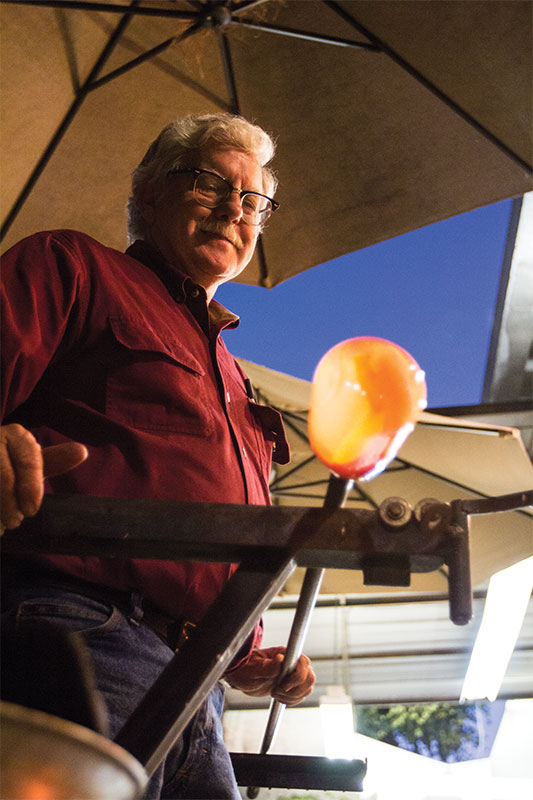
Glass-blowing is the art of coming within inches of a blazing vat of raw materials, which, by some means of chemistry, morphs into beautiful glass vases, bowls, cups and precisely anything imaginable.
Though glass-blowing is typically seen performed by hardy men with calloused hands, the St. Mary Armenian Apostolic Church Ladies Society went against the grain and took it upon themselves to mold the lava-resembling liquid into decorative Easter eggs.
The class took place at Clovis’ Ballis Glass on Saturday, April 12.
Ballis Glass is an industrial, expansive building tucked away into an unassuming street, made known by a small sign posted near the entrance of the parking lot.
The glass-blowing setup entails several machines holding molten glass, a bench with medieval-looking tools next to it and is topped off by a table portraying the different colors one can choose from to make a piece.

Beyond the textbook description of the Industrial Revolution is a room displaying approximately 100 glass pieces including ornaments, honey sticks and pumpkins.
Throughout the class, several women from the church poked around the displays in awe, some muttering phrases like, “I don’t even know how you would do that.” There were even glass cups embellished with swirls made from material gathered at Morro Rock.
The owner of Ballis Glass, Cory Ballis, taught the class with Lead Assistant Nick Vermillion. Ballis, to everyone’s surprise, began the class with a quick, seamless demonstration where he made an Easter egg to show the ladies how it was done.
The popular saying, “jaw on the floor,” materialized into an elephant which stood directly in the middle of the room: how in the world are we supposed to do that?
But, with our acrylic nails polished and our spirits untouched by doubt, we trusted Ballis and Vermillion to guide us through the process of glass-blowing.
This was, of course, after signing a waiver and putting on an unflattering pair of safety glasses.
In an interview with The Collegian, Ballis described what the process specifically looks like.
“The glass is melted in a furnace at 2,100 degrees, then we gather the glass out of the furnace on a pipe, color it and do a design,” he said.
And Fresnans thought that the summer temperatures reaching 110 degrees were hot. Ballis continued.
“We let it cool down a little bit, some people trap bubbles, and then once it was cool enough we took a second gather of glass on top of that and we sculpted that into an egg shape,” he said.

By detailing the glass gathering, Ballis was referring to a step in which a pipe is inserted into a furnace with the melted glass and rolled continuously to prevent the glass from sliding off.
When I completed this step, I made note of how hot I felt standing in front of the furnace, like a temporary sunburn with a much more beautiful outcome.
For Ballis, glass-blowing is a moment of peace, similar to how meditative painting is for painters.
“It’s almost like stress relieving when I’m blowing the glass, although it is a very stressful act,” he said. “It’s one of the hardest things you can probably do in the art scene.”
After the initial demonstration, the class took turns creating the Easter eggs with careful supervision and helpful explanations by Ballis and Vermillion. Laurie Menendian bravely volunteered to go first.
“I’ve always been interested in glass-blowing and the techniques that they use to do that sort of art,” Menendian said. “To be able to actually sit in a building where they’re making glass objects by putting molten glass in fire and shaping it was awe inspiring.”
Menendian explained that she was not nervous, but rather exhilarated.
There were several designs and colors to choose from, from a solid-color egg with bubbles to a double-colored swirl. After the eggs are created, it takes approximately two weeks for them to fully set.
The class reserved a window of two hours, and it was up to Vermillion to ensure that everything ran smoothly and according to time.
“Being a glass-blowing assistant is really all about just keeping everything on schedule,” Vermillion said. “It’s a wild job, but at the same time, I’ve never loved a job more.”
Glass-blowing, like many would suspect, comes with inevitable injury. However, Vermillion explained the frequency of injury expectedly decreases with experience.
“It’s the nature of the beast, if you’re going to play with fire, you’re going to get burned,” Vermillion said. “You just end up learning where your comfort zone is around the hot equipment.”
I will say, although I had twinges of fear in the beginning about handling the glass, attending the class was a rewarding, powerful experience that awakened my inner love for getting my hands dirty.
Because the glass-blowing room tends to heat up, classes are not offered in the summer months and resume in the fall.
Ditch the expectation of losing a finger, and go make your day brighter, and hotter, with glass-blowing.

David Menendian • Jul 5, 2025 at 8:48 pm
Excellent reporting here Anahid. So well done! From David Menendian, former Clovis High School Journalism teacher. And former Daily Collegian reporter.