


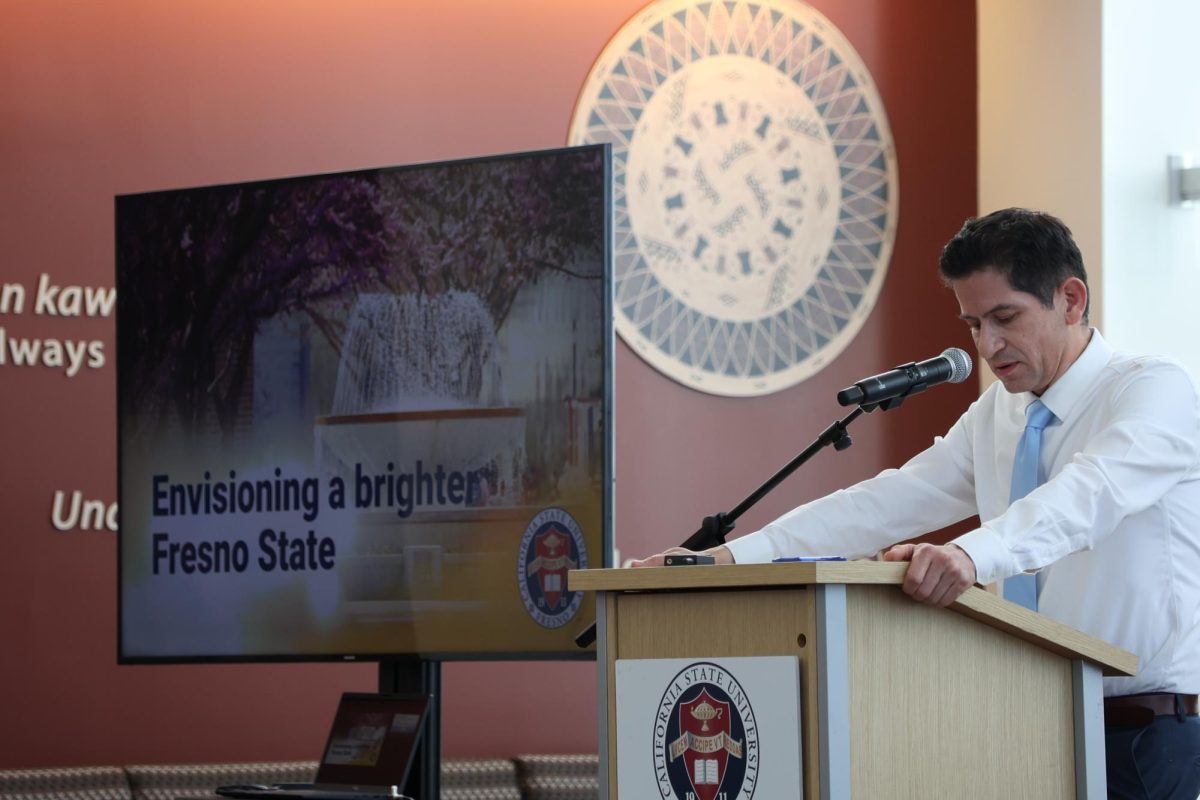
Fresno State President Saúl Jiménez-Sandoval and the Campus Fee Advisory Committee (CFAC) are considering a proposal to increase student fees by $495 a year. If passed, it would begin in the Fall 2025 semester.
This would be in addition to the $132 that students already pay. $92 from that fee goes toward athletics while $30 goes toward instructionally related fees (IRA). The remaining $10 is allocated for academic programs.
Some programs that would receive increased funding include intercollegiate athletics, the Fresno State marching band, The Collegian, the Bulldog Express shuttle and The Amendola Family Student Cupboard.
Campus and community open forums were hosted on March 4 and March 6 to gather student voices and input.
Each forum had around 20-30 students in attendance and began with a presentation on what the increased fee would be funding.
The proposal is separated into three categories that are related to student success. Each forum ended with an open mic to ask questions and raise concerns.
Student concerns
After each forum, multiple students asked if students can see how much money will be allotted to each category.
“We’ll make it available,” Jiménez-Sandoval said. “We’ll also make the proposal available for feedback as well.”
One point mentioned in the presentation was the fact that 58% of students will have this fee increase covered by things like financial aid and scholarships.
Despite this, Associated Students, Inc. (ASI) senator of veteran and transfer affairs, Carlie Hall, shared her concern during the forum.
“I also feel that the presentation kind of fails to recognize that at least 42% of our student body is going to be hit with a nearly $500 fee increase,” Hall said. “And to the administration and the people with full-time jobs, that doesn’t seem like a lot of money, but to the average college student, that’s a huge expense and I feel that there needs to be more accountability.”
Other questions were raised on what Fresno State is doing to combat the state budget cuts aside from raising student fees.
“Since we’re covering essentially the cost of bettering the programs that are going to benefit us, what is the university going to do to help offset those costs that are now coming to students,” said ASI vice president of finance, Guadalupe Zamudio Telles.
Jiménez-Sandoval talked about how last year Fresno State had the second highest fundraising amount in the school’s history. He also mentioned that he has been meeting with elected officials and trying to gain support for Fresno State.
In a similar sentiment, Camalah Saleh, a student double majoring in political science and communication, raised concerns about why students are the ones impacted the most by budget cuts.
“What roads have been crossed before we got to student fees,” Saleh said. “Because it feels like whenever funding is cut, and our funding does get cut, it always falls back on the students.”
Jiménez-Sandoval responded that in the last 16 years, student fees have not been increased for student services specifically.
“I find myself in a situation in which finances are just simply not coming to the foreground,” Jiménez-Sandoval said. “And I find myself in a situation in which I have no other choice.”
The three categories of the proposal are academic success, student supportive students and student life.
Click here to see the full proposal with every program and resource that would see increased funding along with a rationale for each one.
Category one: Academic Success
Some of the funds will go to support services on campus, such as the Learning Center, for things like supplemental instruction. This is in order to help students pass difficult classes like Chemistry and 1A, which has had a 30% fail rate for the last 30 years.
“So with this fee, we will cover almost 50% of all students with these wicked gateway classes that stump our students,” Jiménez-Sandoval said.
Another part of the fund would go towards The Collegian that hasn’t had an increase in funding since 2011. This would double the money allocated from $11 a year to $22. This would allow for more editors, reporters, increased support for its ethnic supplements and more news coverage.
The Jan and Bud Richter Center will also see an increase in funding. Jiménez-Sandoval highlighted the fact that Fresno State provides 1.5 million hours of community service per year and that this increase will provide 60 new paid internships that will help manage community service coordination.
Additionally, an extra 850 paid internships will be created with the Career Development Center, according to the proposal.
Category two: Student Support Services
The Amendola Family Student Cupboard will be able to expand on their selection and quantity of nutritious fruits, veggies, carbs and proteins.
“We will also have satellite snack stations throughout the campus with basic nutritional snacks for you [students] in order to combat food insecurity as well,” Jiménez-Sandoval said.
A revival in the Bulldog Express shuttle service is also on the table in the proposal. This would connect the SaveMart Center parking lot to the rest of the campus so students can avoid the long and time-consuming walk to their class.
Derek Brantley, Fresno State Parking and Transportation manager, discussed why more money is needed for this service.
“They’re [parking fines] 50% less than they were in 2017,” Brantely said. “And we’re really proud of that, but the Bulldog Express budget was funded 100% out of fines and with that soft money source, if you write less fines, that bill becomes nearly impossible to pay.”
Category three: Student Life
The proposal seeks to provide more money for club sports and intramurals. This would benefit the 23 club sports that are offered on campus and allow for more opportunities to compete at higher levels and showcase Bulldog pride.
Fresno State’s Marching Band will also gain much needed support that will allow them to maintain and improve their program.
Then there’s Intercollegiate Athletics. This fee proposal would go towards funding Fresno State Athletics, an expanded Name, Identity and Likeness (NIL) training program and a new Sports Management Internship program.
Garrett Klassy, Fresno State athletic director, assured the people at the forum that none of the money from the fee will go towards funding the expenses of NIL following a question from a student.
“This isn’t to be paying players, ” Klassy said. “This is to create opportunities and enhance what we’re already doing.”
A page on the Fresno State website is dedicated to this proposal and has all the information discussed during the presentation. A survey is also included in order to gather student feedback.
The CFAC will meet with Jiménez-Sandoval at the end of the month to discuss the feedback and make a decision.


D. Housepian • Mar 11, 2025 at 6:11 pm
It was asked by ASI vice pres. of finance, “…what is the university going to do to help offset those costs that are now coming to students.” The cost for a student to attend Fresno State is one of the lowest cost universities to attend among the CSU’s and UC’s. By holding back on increases to the students, as long as we have to help the students, is why it is now imperative that this increase happens. It is not an option.