
Just to preface, going into “Buddy: The Buddy Holly” musical, I had absolutely no prior knowledge of any of the artist’s discography. I didn’t know his story or rise to fame in the slightest. The most I had ever heard of him was in the movie “La Bamba” and how he, alongside Ritchie Valens, was one of the four ill-fated passengers to die in a tragic plane crash.
With this in mind, I find it all the more interesting that I left the Theatre at Roger Rocka’s that night as a mild fan of Buddy Holly.
This musical is very true to its genre, a jukebox musical. It plays much more as a tribute concert than an actual musical with a through-line narrative. And for someone who went into this knowing absolutely nothing about Buddy Holly or his impact, I feel as though this show wasn’t exactly tailored for me.
But then again, I would argue: who exactly is this show tailored to? I have a suspicion that there aren’t many passionate Buddy Holly fans around anymore, at least not within my generation.
Regardless, I would’ve liked to have delved deeper into Holly’s rise to fame. All of the conversations held behind studio windows and such seem almost generic to me, since I’ve seen so many of these exact scenarios in other media.
Surely, there must have been something that set Holly’s rise apart from every other singer’s rise to fame. Especially considering the impact this artist had on music. Holly’s music has influenced countless musical groups, such as The Carpenters and The Beatles. Had I not done curious outside research on Holly after the show, I wouldn’t have gotten the full understanding of Holly’s important impact on the music industry.
One thing that was absolutely made clear, though, was the charming set onstage. There is a 1950’s aesthetic that makes complete sense, given that Holly’s rise to fame mainly occurs during that decade. Graphic stars and pastels adorn the set, complete with a mock radio host desk off to stage left that really includes you in the show.
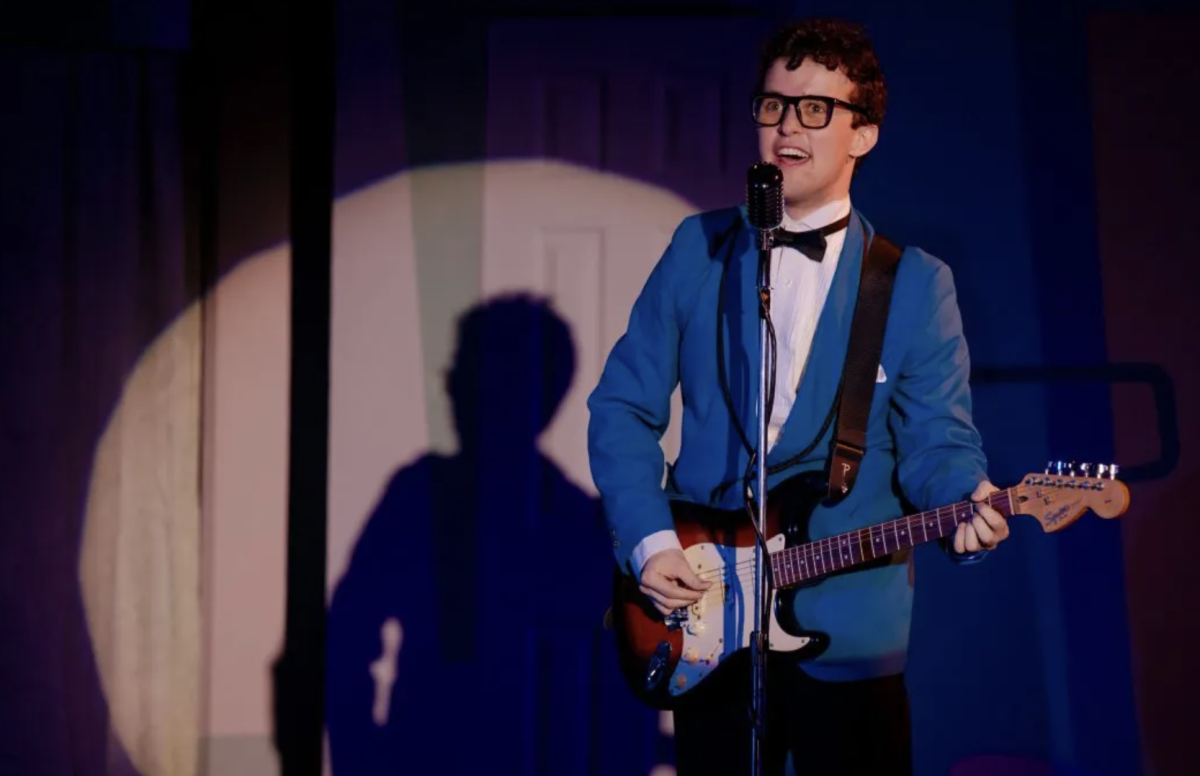
But perhaps what was even more impactful were the performances. Namely, of Mr. Holly himself, portrayed by the talented Daniel Montgomery in his theatre debut at Roger Rocka’s. Coming from someone who has performed in several shows at this theatre, it’s such an accomplishment for Montgomery to have landed a leading role in his DEBUT show.
And I can see why. He truly gives his all to the many demands the role presents to him. Even in the sparse, quieter moments of the show, I could see that Montgomery is an active participant in the narrative and always present in the moment of his character. It was easy to tell that he truly wants to do right by Holly, giving the part the vocal flair and physicality required.
The other standout performance for me is Diego Sosa as Ritchie Valens. Just as the concert- and I do mean concert- of the second act nears to its end, Sosa electrifies the audience once more with his rendition of “La Bamba” with all the hip swaying, and winks to the audience as much as possible, to great effect. In an overall slow-paced second act to this show, that moment provided the much-needed boost to carry us over the finish line.
Izsac Valencia also gives a passionate performance as The Big Bopper, complete with an amazing hairstyle, might I add. He, like the rest of the ambitious cast, gives his all to a vocally demanding part.
The rest of the cast gives their all in the many songs and choreography in the show. There is a scene in the show, however, that had me rolling out of my seat in laughter. Rex McTeer plays The Crickets bassist Joe Mauldin, and during one of the many songs, McTeer throws himself onto the floor and cradles his bass in his arms, still playing his strings for the band, complete with a hilarious expression.
That energy and charm are really a perfect embodiment of the show for me. It’s incredibly energetic and pays tribute to its subject respectfully. But it does have a very dumbed-down story that, in the end, left me wanting a deeper and more thorough understanding of Buddy Holly’s story. For being named “Buddy: The Buddy Holly Story”, it’s ironic that I found there was much of a story present here in the end.