

It took months for Fresno State’s Academic Senate to pass a watered-down version of a policy that started out by requiring professors to teach at least 50% of their classes in person.
During its April 13 meeting, faculty senators scraped together enough votes to approve a compromised version of their Faculty Rights and Responsibilities policy (AMP 336). The guidelines skip the percentage requirement and instead simply discuss personal responsibility and governance of the university.
Throughout this lengthy process, the senate conducted multiple readings of APM 336, which considered the opinions of senators from different programs and departments on campus.
The Collegian tracked the slow and unsteady progress of the proposed revisions to APM 336 by attending meetings and conducting several interviews.
The 50% in-person attendance requirement fell under the seventh guideline, in which tenured faculty would have needed to teach at least 50% of their workload face-to-face. Some representatives said it was a problem because certain Fresno State departments rely on outsourced professors to teach accredited courses.
Supporters of the “50%” threshold argued that the policy would have increased school culture and professor accessibility for students. They said students fail online classes at a higher rate, and facilities are less likely to get funded if professors and students do not use them.
Camalah Saleh, Associated Students, Inc. president, provided a student’s perspective.
“With the online courses, I have not connected with any of the faculty or felt like I should, but in person I’ve made mentorships,” Saleh said in an Academic Senate meeting on Feb. 2.
“I do prefer in-person classes; however, I recognize that not every student shares this preference,” Saleh said in an email to The Collegian. “Many students have unique circumstances: they work full time, have families, or need the flexibility that online courses offer.”
Critics of the “50%” threshold said many departments rely on outsourced professors, definitions of “school culture” are too subjective and the policy does not solve the root issue of faculty productivity and student involvement.
At the Academic Senate meeting on Feb. 2, Justin Myers, senator for the Department of Sociology, said that the 50% threshold is “problematic” and “subjective” as some people have different perceptions of an enriched school culture.
“This policy represents a pretty significant, expanding administrative power over faculty, and my concern is that you [administration] might make faculty vulnerable to managerial misuse,” Myers said, reciting what a sociology professor said.
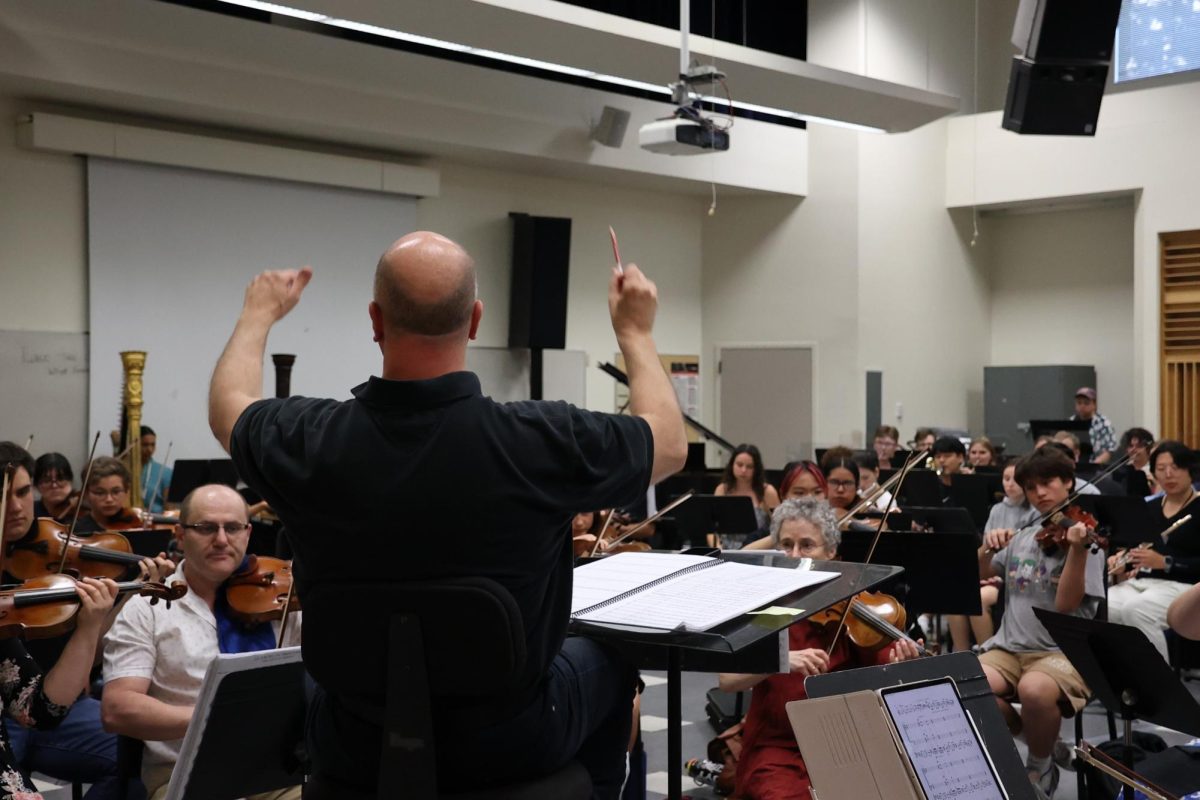
The senate meetings, lasting an hour and fifteen minutes, started off relaxed, but quickly became an assertive environment as senators put forth their opinions on the attendance policy. As one senator shared their perspective, two more would raise their hands, leading to a tedious and passionate process.
In February, Thomas Holyoke, the university-wide delegate for the Academic Senate and a political science professor, shared his thoughts on online teaching with The Collegian.
“To me, this is not a good way to teach and denies students the opportunity to have the full university experience,” Holyoke said. “It also seems to me that if a person accepts a faculty job at a university, you should actually come to that university during the work week, at least for a while. You don’t need to be on campus for 40 hours a week, but perhaps 15 or 20.”
The 50% policy raised concerns for some faculty members in the College of Health and Human Services and the College of Social Sciences. Those members said that some departments rely on accredited faculty members and “experts” from outside of Fresno to teach courses. It is often more cost-effective to offer those kinds of classes online.
There is a large difference between the number of online courses provided by the colleges at Fresno State. According to the Office of Institutional Effectiveness, the Lyles College of Engineering had 30 online classes in Fall 2024, whereas the College of Social Sciences had 230 courses. It is important to note that the School of Social Sciences holds many general education courses.
Shauna Miller, senator for the School of Nursing, shared her concerns regarding the in-person policy. About 23 School of Nursing courses were online in Fall 2024, and the school saw a decrease of three online courses in Fall 2025.
In an email to The Collegian in February, Miller explained that the School of Nursing only allows professors approved by the California State Board of Nursing guidelines.
A majority of these approved professors do not live in Fresno, resulting in online courses. For example, a nurse teaching a community health course is not permitted to teach any other course under the School of Nursing. Due to this, the number of approved professors is limited, but the students’ demand for the courses remains the same.
“I believe there is an exception for the SoN [School of Nursing], but it is not clear,” Miller said. “I don’t believe this policy will be supported by our bargaining agreement.”
The policy change highlights that the 50% rule can have exceptions; it is not clear yet in what ways.
At an Academic Senate meeting on Feb. 3, Raymond Hall, senate chair, said the policy would act as guidance for chairs and deans. Xuanning Fu, provost and vice president of Academic Affairs, suggested that the 50% rule would be slightly relaxed.
According to Fu, the 50% policy was intended to create a sense of self-awareness of contribution among faculty members and encourage team productivity. He did not elaborate on how different departments or colleges vary from the 50% rule.
According to Lisa Bell, Fresno State’s former public information officer, Fu was not providing additional comments.
In regard to the relaxed policy, some senators shared their concerns.
“Some departments are doing it strictly, and other departments are not,” said Andrea Roach, senator for the Department of Child and Family Science. “And that then creates a feeling of animosity across the campus towards those who are versus those who are not.”
Amanda Mortimer, senator for the Department of Psychology, said that students tend to fail online classes at a higher rate.
“[The policy] gives us the ability to tell that faculty member who only wants to teach online that it is not in our program’s best interests,” Mortimer said. “But it also gives the department of program the opportunity to say, ‘we don’t actually need to do it this way.’”
Members of the Academic Senate cheered as this tedious process came to a close on April 13. But, those cheers slowly turned into humorous sighs as they realized the next policy on the revision block is APM 328, a set of guidelines used to evaluate tenured faculty.