
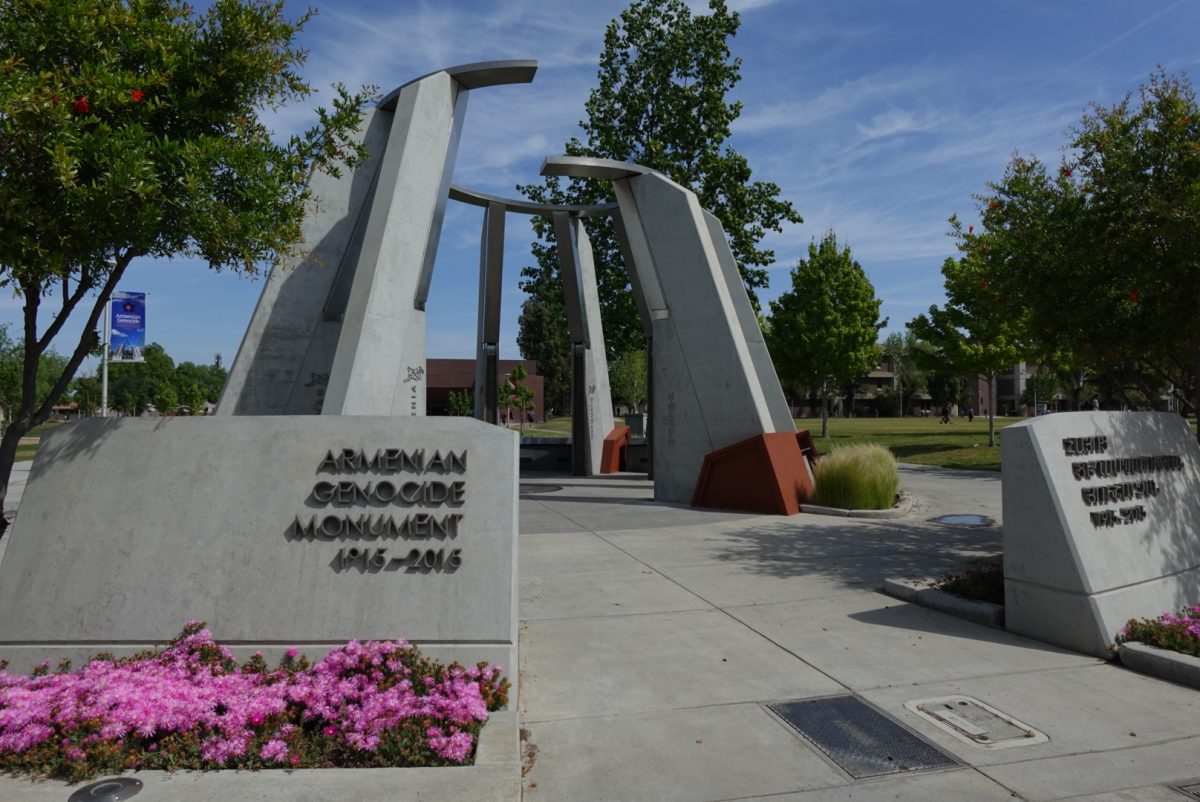
In honor of Armenian Genocide Remembrance Day on April 24, the Armenian Students Organization (ASO) and the Armenian Genocide Commemorative Committee of Fresno (AGCC) are organizing events to honor the victims of the genocide.
“Representatives of Armenian community organizations have been planning the April 24 event for a year; they meet regularly to discuss all of the details,” said Barlow Der Mugrdechian, the Berberian coordinator of the Armenian Studies Program and the director of the Center for Armenian Studies.
The Armenian Genocide began on April 24, 1915, when the Ottoman Empire officials rounded up several hundred Armenian leaders and intellectuals and executed them. This event is marked as the beginning of the genocide that continued until 1923, though violence and massacres against Armenians had been occurring for decades prior.
In the end, approximately 1.5 million Armenians were murdered, leaving their people orphaned from their country and separated from each other.
On Thursday, the Armenian Studies Program will be screening a movie called “Mayrig,” or “mother” in Armenian, at the University Business Center. The film follows a family’s experience after surviving the genocide and moving to France.
At 12 p.m. on Friday, the ASO will hold a commemoration event at the Armenian Genocide memorial on campus. This event will have music, speakers and a laying of the flowers ceremony.
Later, the AGCC will hold another event at the monument, beginning with a laying of the flowers ceremony at 6:30 p.m. and a formal program at 7 p.m.
Keynote speaker and filmmaker Ani Hovannisian will speak during the evening program that encompasses live performances from Armenian youth, religious leaders and remarks from community leaders.
“The Armenian Genocide Monument is the only such monument on a college campus in the United States,” Der Mugrdechian said. “The monument is intended to commemorate, educate and inspire.”
Der Mugrdechian said the oppression and slaughter of Armenians for decades and centuries before April 24 was largely due to religious persecution.
As the Ottoman Empire began to crumble in the late 19th century, the Armenians continued fighting for basic civil rights. Turkish nationalism was on the rise, and the Turkish Committee for Union and Progress had taken over the Ottoman government.
“They lost a lot of territories, and they were scared that they were also going to lose Eastern Anatolia, which was historically Western Armenia,” said Anna Aleksanyan, a genocide scholar and Kazan visiting professor at the Armenian Studies Program. “When the war started, they decided to solve this ‘Armenian question.’ No Armenians, no Armenian question.”
After the deportation and execution of several hundred Armenian leaders and intellectuals on April 24, the Ottoman Empire began a large-scale deportation of all Armenians. They killed all Armenian soldiers fighting for the Ottoman Empire, and they started rounding up and deporting women and children.
Many women being deported to the Syrian desert were murdered, raped and beaten on the journey, and if they weren’t killed by a Turkish prisoner tasked with “guarding” Armenians, they most likely died of malaria in transit camps.
“The instigators realized that many Armenians were surviving,” Aleksanyan said. “So they decided to come to the ‘final solution’ to just liquidate all of the concentration camps by taking them further into the desert to massacre them.”
After the genocide ended in 1923, many Armenians who survived were displaced from their homes. They have continued to deal with oppression in other areas, with the most recent large-scale example of this being in September 2023, when 100,000 Armenians were forced to flee the ancient-Armenian region of Artsakh in fear of Azeri forces.
“It’s important to hold these events at Fresno State because the Armenian community of Fresno is old, and it plays a tremendous role in this community,” Aleksanyan said. “You cannot go back to your homeland, your cultural heritage is destroyed. You come to this foreign land, but you are still so resilient to rebuild a new life and become someone valuable.”
The Armenian Genocide events are free for all students and community members who would like to attend and commemorate the victims of this historic tragedy.