

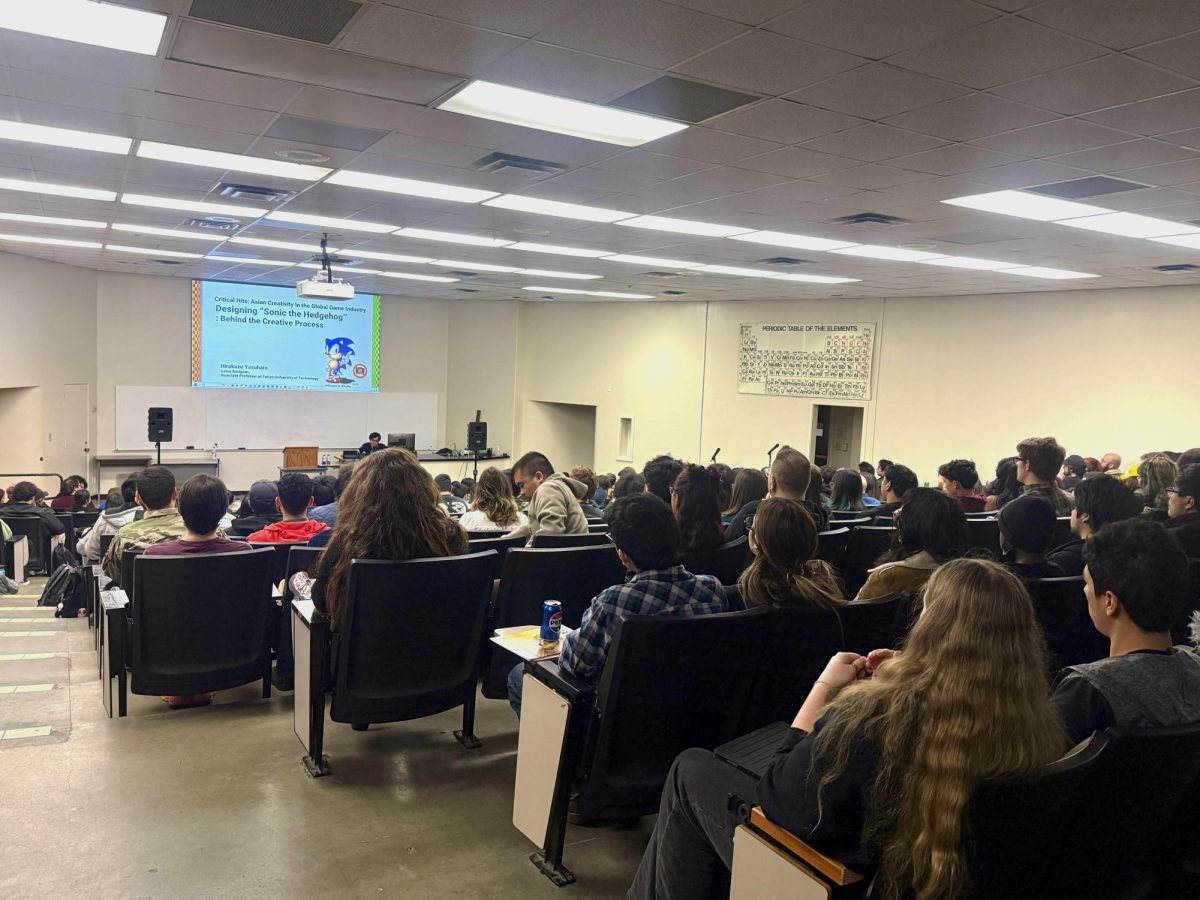
The original Sonic the Hedgehog level designer, Hirokazu Yasuhara, came to Fresno State on Feb. 20 to talk about how he first got into the gaming industry, how to design video game levels to be enjoyable to the player and the creation of Sonic the Hedgehog.
Lori Clune, a history professor at Fresno State, and her son, Zac Emerzian, a Fresno State alumnus and associate technical designer at Second Dinner game studio, kicked off the presentation with a lecture about the history of video games and gaming culture.
Yasuhara, a professor at Tokyo University of Technology, then went into his presentation, describing the events that led up to him getting his job at Sega. At age 18, he did not get into college for architecture like he wanted. He then reluctantly enrolled in machine engineering, where, at age 20, he joined a film club.
He then wanted to get into filmmaking, but Japan’s film industry was hard to get into. This caused him to pursue other career options. At 22, he took an interest in Namco due to its leading amusement parks and changed his interest to wanting to design rides for entertainment.
He went in for an interview and saw that 200 other people were in line, he saw the crowd of people apply and quickly gave up due to being intimidated. When he got to the train station he remembered that the company, Sega, was in the same town, and they created small ride game machines, so he called and asked for an interview over the phone.
He was then told to come in immediately since the boss was in the building. After going in, he was hired at Sega immediately.
Yasuhara joined the company because he wanted to make ride attractions, but on his first day, he was assigned to the Sega console. Yasuhara said he had little knowledge of games, but quickly studied. His knowledge and passion for architecture, engineering and film helped him along the way to be prepared for his video game work.
After his backstory, he explained why Sonic the Hedgehog is Sonic the Hedgehog. Yasuhara talked about how Sega wanted a high-speed scroller game with intuitive controls, which led to a hedgehog creature that could curl up and attack enemies.
He and the rest of the Sonic team looked for fast-sounding names. They wanted blue to match Sega’s color, and they wanted something easy for children to draw. They also asked the question “what does it mean to be cool?” as well as discussing the theme of nature vs. environmental development.
Yasuhara showed inspirations for the characters in the series, with inspirations from Disney and Hanna-Barbera for the cartoon aspect and members of the team personal artistic touches, all of these questions and deep developments came to create Sega’s mascot, Sonic the Hedgehog.
Yasuhara talked about the long hours he worked at Sega, which were sometimes up to 18 hours a day, during the process of Sonic’s creation. He was tasked with the level design, and explained to the audience what aspects of level design makes a game fun.
With the help of interpreter and Fresno State professor Hanayo Oya, he explained that the team would have to transfer data to the Sonic team in America, and with how slow transferring data was in the 1990s, it would take hours and risk error messages that would restart the process. The slow data transfer is what led to Yasuhara staying late in the office and explaining the 18 hour work days.
His goal for the design of Sonic the Hedgehog game was to combine the joy of learning with the joy of experiencing, and creating a balance. He wanted the game to be like an amusement park where the player can both have fun and still add elements where players learn, so that the experience of playing does not dull over time.
Shortly after that, Yasuhara took questions from the crowd with the help of translators Conor Youhei Hustedde and Taeyo O’Connor, where many crowd members asked more in-depth questions relating to his past as well as Sonic and game philosophy.
“He is very happy to see the community grow and adore Sonic,” Oya interpreted for Yasuhara.