
Every time the Winter Olympics come around, the debate of whether an event is serious or not is always brought up.
Curling is one of the sports put under this spotlight.
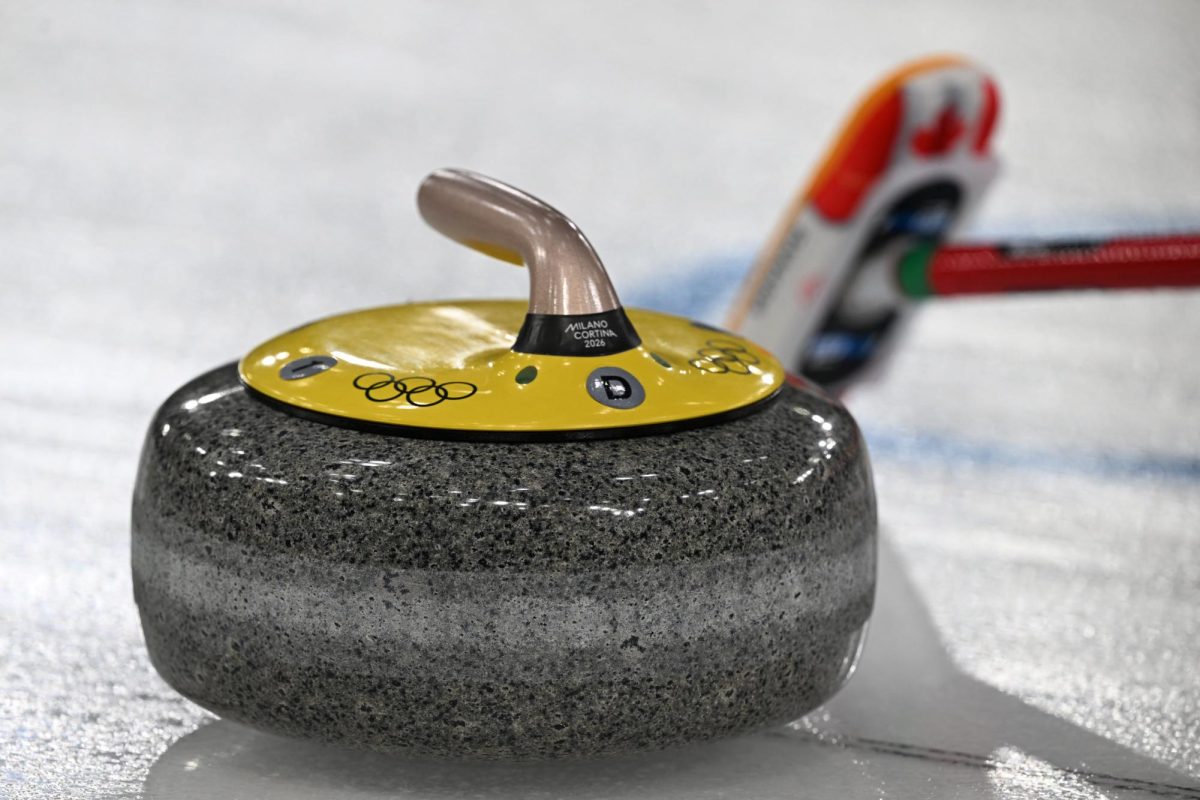
Curling is a Winter Olympic sport in which athletes throw granite stones into an area, called the house, to get as close to the center as possible to score points.
Teams manipulate the stones by sweeping in front of the stone to make it travel further, or turn more to navigate into the house.
The sport returned and has remained a medal sport since the 1998 Winter Games.
Anahid’s thoughts
The Winter Olympics are a chance for some of the world’s greatest athletes to show off their life’s work.
There’s skiing, where human beings must learn to conquer the snowy mountains. There’s ice hockey, where people slam into one another and fight to score a goal. There’s even ice skating, where one must achieve the perfect equilibrium on a thin blade, beating the shakiness of their nerves and the slipperiness of the ice.
And then there’s curling, somehow mixed into all of this. It should not be considered a sport — let alone an Olympic sport.
The entire premise of curling is to slide a slab of granite across ice and into a target, known as the “house.” It’s like if hockey and archery combined into something less cool. A lot less.
Now, curling certainly requires some sort of stamina and training. A player’s core is probably engaged, and they must have to build a decent amount of arm strength. However, a lot of things require these.
For example:
- Bringing groceries inside the house.
- Carrying around a large tote bag.
- Holding a small dog.
- Picking up boxes.
- Recreational bowling.
Just because something can be made into a challenge or a game doesn’t mean it has to automatically be a sport.
Curling dates back to 16th-century Scotland, when people used to slide stones across frozen ponds. At the time, it was referred to as a “roarin’ game,” due to the sound that the stones made when travelling across ice.
This sounds like a harmless childhood game, not an opportunity to win an Olympic gold medal.
Even the World Curling website admits it, to some extent.
“What is clear, however, is that what may have started as an enjoyable pastime of throwing stones over ice during a harsh Northern European winter has evolved into a popular modern sport with its own world championships, which attract fans and large television audiences,” the website says.
They’re right. It has built a solid foundation and a large audience. I just can’t, for the life of me, understand why.
Shockingly, this topic is highly debated online. One Reddit post has users debating about the validity of curling, and the main argument for curling fanatics is that it’s difficult. But the responses are even better.
“It doesn’t matter if it’s the hardest sport ever, they just look dumb as s— doing it,” one user beautifully said.
Personally, curling, in the context of sliding stones across a frozen lake, looks relatively appealing. And I couldn’t care less if that’s how people want to spend their free time in particularly cold winters.
What I do have a problem with is that this mere hobby takes up space in the Olympics. I say we leave it where it’s supposed to be: the category of pastimes.
Juan’s thoughts
Many may view curling as just throwing a stone and sweeping, but there is a lot more to curling than that. Beginners who are trying the sport to see how difficult it is often have difficulties performing the sweeping and throwing of the stone.
The 2018 U.S. men’s curling team trained an average guy named Clay Skipper on how to play a curling match, and to say the least, he struggled. This video shows just how physically demanding it is. Adding on to this, the Winter Olympic curling matches that are being played are 10 ends long, similar to innings in baseball, and last roughly three hours.
The Winter Olympic teams are often playing two matches a day, every day during the Winter Games, with some athletes doing double duty in mixed doubles as well as the main team event.
To say curling doesn’t belong in the Winter Olympics is unfair to its athletes and fans. Curling may only become nationally popular every four years, but it still brings the same excitement, highs and lows any other sport does.
Take the U.S. women’s team round-robin match against Great Britain. The U.S. led by two in the final end, but Great Britain’s Rebecca Morrison hit a shot to steal two points and beat the U.S. after they led the entire game.
This shot is the equivalent to a game-winning field goal in football or a walk-off home run in baseball.
Or how about John Schuster’s five-point shot during the 2018 Winter Games for the U.S. men’s curling team to upset Sweden and win gold.
Not only is there the physicality of sweeping, but there is the mental side of curling that goes underappreciated.
The sport is often referred to as “chess on ice” and is a lot more complex than just throwing stones into the house for points. Guards are thrown to try and block the other team from scoring, while other plays, such as double takeouts, exist to swing the momentum of an end.
While many athletes on the Olympic curling team do have careers and, more so, play curling as a side hobby, I argue that’s what makes the sport unique. All of these athletes come from different walks of life. The fact that the U.S. women’s curling team will be playing for a medal and the men’s team was the youngest in the tournament, while pulling off numerous upsets, is what the Winter Olympics are about.
Even the U.S. mixed doubles team had their own Cinderella story this Winter Olympics. Korey Dropkin and Cory Thiesse were the first U.S. mixed doubles team to make it past round-robin play and won the first mixed doubles medal in team history, despite falling to Sweden in the gold medal game.
These are the stories that make us watch the Winter Olympics, even curling.