


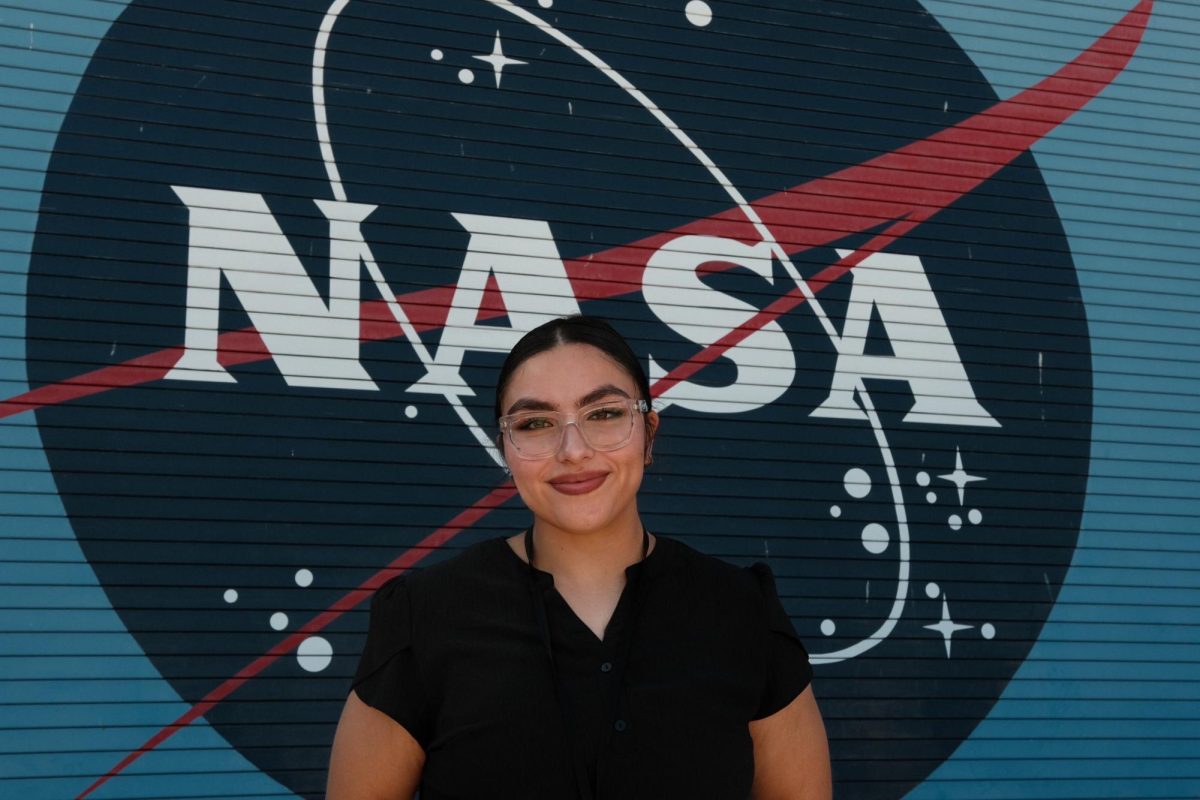
When Dana Martinez arrived in the United States at 13, she felt like she had stepped into an entirely new world with a new language, new schools and new expectations. What she didn’t realize was that the biggest challenge wouldn’t be culture shock, but navigating college as a first-generation student with no roadmap.
Today, that journey is an hour-long commute each way from Firebaugh to Fresno State, a routine that adds to the challenges she balances as a first-generation mechanical engineering student.
“I didn’t have anyone at home who could guide me through college,” Martinez said. “My dad didn’t finish, my older brother didn’t finish and the other one didn’t live with us. I had to figure everything out on my own.”
Martinez’s experience reflects a broader reality at Fresno State, where about 64% students are the first in their families to attend college and often enter fields without built-in support systems. For first-generation women, pursuing Science, Technology, Engineering and Mathematics (STEM) can be especially isolating.
“Engineering is often seen as a white, male-dominated field,” said Sergio Figueroa, Martinez’s partner. “Many females from Hispanic households can attest to the sad reality of the expectations parents hold of their daughters. Many expect their daughters to pursue more female-dominated fields.”
At first, Martinez followed the path her parents understood: become a teacher.
“Hispanic parents always want their kids to become professors or teachers,” she said. “I was really close to finishing. But I felt lost.”
The turning point came unexpectedly. A friend she once had, attending the University of California, Berkeley for electrical engineering, sparked her curiosity.
“She kept talking about engineering, and I wondered, ‘What even is engineering?’” Martinez said. “I looked it up, and I realized I liked math. Then I saw that mechanical engineering links to aerospace, and suddenly, everything clicked.”
Switching majors wasn’t easy. She lacked calculus and physics preparation from high school, making her feel behind her peers. Entering a male-dominated field brought its own challenges.
“Sometimes there are only five girls in a class [with] twelve guys,” Martinez said. “And in group projects, women often get pushed into the secretary role. You’re doing all the reminders but never leading. That’s when I realized I needed to build a strong personality.”
At Fresno State, women make up about 24% of students in the civil engineering bachelor’s program, according to a university profile published by Fresno State Today.
Her determination paid off. She found mentors and community through the Society of Hispanic Professional Engineers (SHPE) and the Society of Women Engineers (SWE).
“SWE changed everything,” she said. “I met first-gen students who had been in my shoes. They understood. I finally felt like I wasn’t alone.”
The support network helped Martinez improve her grades, navigate group projects, and build confidence to assert herself in male-dominated classrooms.
“Dana is one of the most hardworking students I have met at our college,” said Natalie Maciel, Martinez’s close friend and senior at Fresno State. “Dana will spend most days in the library until closing, typically past 11 p.m., and will be on campus during weekends regardless of her hour-long commute.”
Beyond academics, Martinez also pursued extracurricular passions. She joined Fresno State’s rocketry team, which competes with universities nationwide and works in partnership with NASA. Last year, her team placed 17th out of 40 schools. Next year, they hope to launch their own rocket.
The pinnacle of her experience came via email: a NASA internship offer.
“I thought they made a mistake,” Martinez said. “I couldn’t believe it. Then I spoke with my mentor, a woman engineer named Kristen, and she told me, ‘We’re glad we’re hiring you. We need more women here.’ That changed everything.”
Her family’s reactions were supportive but cautious. Her father always encourages her engineering path, but he worries the most when she is required to travel far for jobs or internships. Her older brother’s concern was less about the engineering itself and more about the financial strain of college, while her mother offered her unwavering support through and through.
“‘Whatever makes you happy,’ she said,” Martinez said. “That meant everything.”
Today, Martinez is focused on finishing her bachelor’s degree in mechanical engineering with plans to pursue a master’s degree in aerospace engineering. She wants to continue in the aerospace field, potentially at NASA or another company where she can design airplanes or rockets.
When asked if Martinez had any advice for students who may be in a similar situation as she was, she encouraged hard work and persistence.
“Don’t give up,” Martinez said. “Engineering is hard. People might underestimate you. But if you know what you want even a little, that’s enough to keep going.”
Her journey reflects more than academic achievement — it’s a story of resilience, mentorship, and carving a place in spaces that weren’t always made for her.
“I’m finally where I’m supposed to be,” Martinez said. “And I’m doing it for myself.”





natalia martinez • Feb 8, 2026 at 12:13 pm
So proud of you Dana!
Maria • Jan 30, 2026 at 12:30 pm
That so inspirational 🙌