
For nearly 100 years, alebrijes, or mythical creatures, have existed in Mexican culture, brought to life by Pedro Linares in 1930. Similarly, nahuales are pre-Hispanic, Mesoamerican mythology figures that can transform into animals.
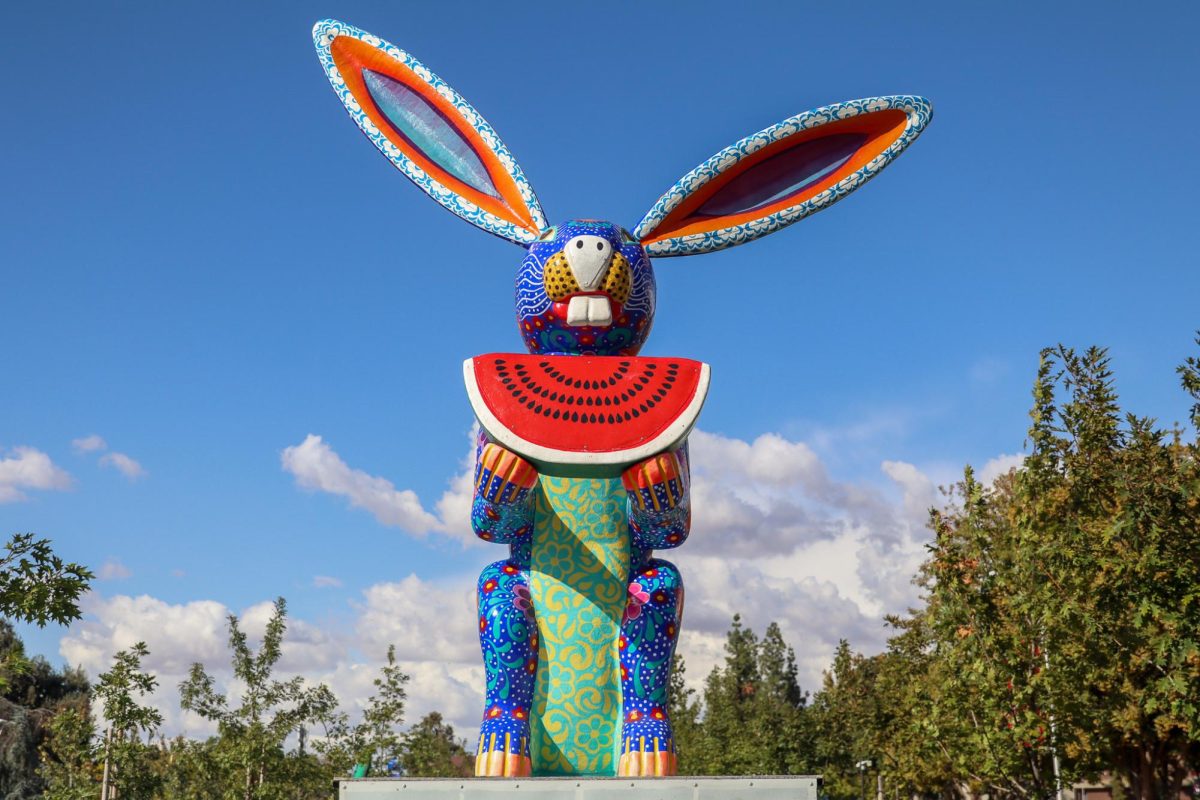
Now, courtesy of Arte Américas, an art exhibition, titled Figuras Monumentales, features several 20-foot-tall alebrijes and nahuales placed around Fresno for the entire community to enjoy, including at Fresno State.
Linares was a papier-mache artist and had a dream one night of unusual animals. He awoke and created the mythical beings from his dreams. Thus, alebrijes were born. Nahuales do not have an exact conception, originating from the Mayans, the Aztecs and other prehistoric groups.
“The goal of this project is to introduce and share these two unique forms of art making,” said Executive Director of Arte Américas Arianna Paz Chavez.
The exhibition runs until Dec. 7, for all individuals to enjoy.
“I liked the patterns a lot, especially the colors,” said Luis Alaniz, a high school student on a field trip. “It reminded me a lot of Mexico because you see a bunch of stuff like this over there.”
The two statues at Fresno State are the Rabbit and the Coyote, which were placed on campus after President Saúl Jiménez-Sandoval went around the Library and polled approximately 130 random students, asking which statue they liked best.
There is another statue at Fresno City College, and the rest are on display at Arte Américas in Downtown Fresno.
Jimenéz-Sandoval is from Zacatecas, Mexico, and was a first-generation college student.
“Seeing these symbols of Mexican creativity and spirit here at Fresno State feels like a bridge between my heritage and our collective campus identity — one rooted in diversity and expression,” Jiménez-Sandoval said.
Located in the quad in between the Joyal Administration Building and the Speech Arts Building, some students walk by the statues, admiring them and inquiring about what they mean.
Caitlin Watson, a speech pathology major at Fresno State, said when she first saw them she was intrigued, and enjoyed the statues’ presence.
“It changes stuff up and I think it just lets us see different art styles and I’ve never really seen art like this, so I think it’s nice that we get to experience stuff on campus that lets us learn that type of stuff,” Watson said.
Arte Américas leaders are advocates for Hispanic culture, and their goal is to increase cultural diversity and awareness while making the community feel included.
“That goal is to really remind our community to stand tall and to take up space, especially in this moment, and to continue celebrating our traditions and to continue celebrating our differences,” Paz Chavez said.
The statues are also a part of the Día de los Muertos celebration, or Day of the Dead, which is a Mexican tradition to honor and remember the lives of those who have passed.
“These sculptures bring art and culture into the heart of campus life,” Jimenéz-Sandoval said. “They invite our students to pause, reflect and celebrate creativity — reminding us that art connects us all, beyond language or background.”