


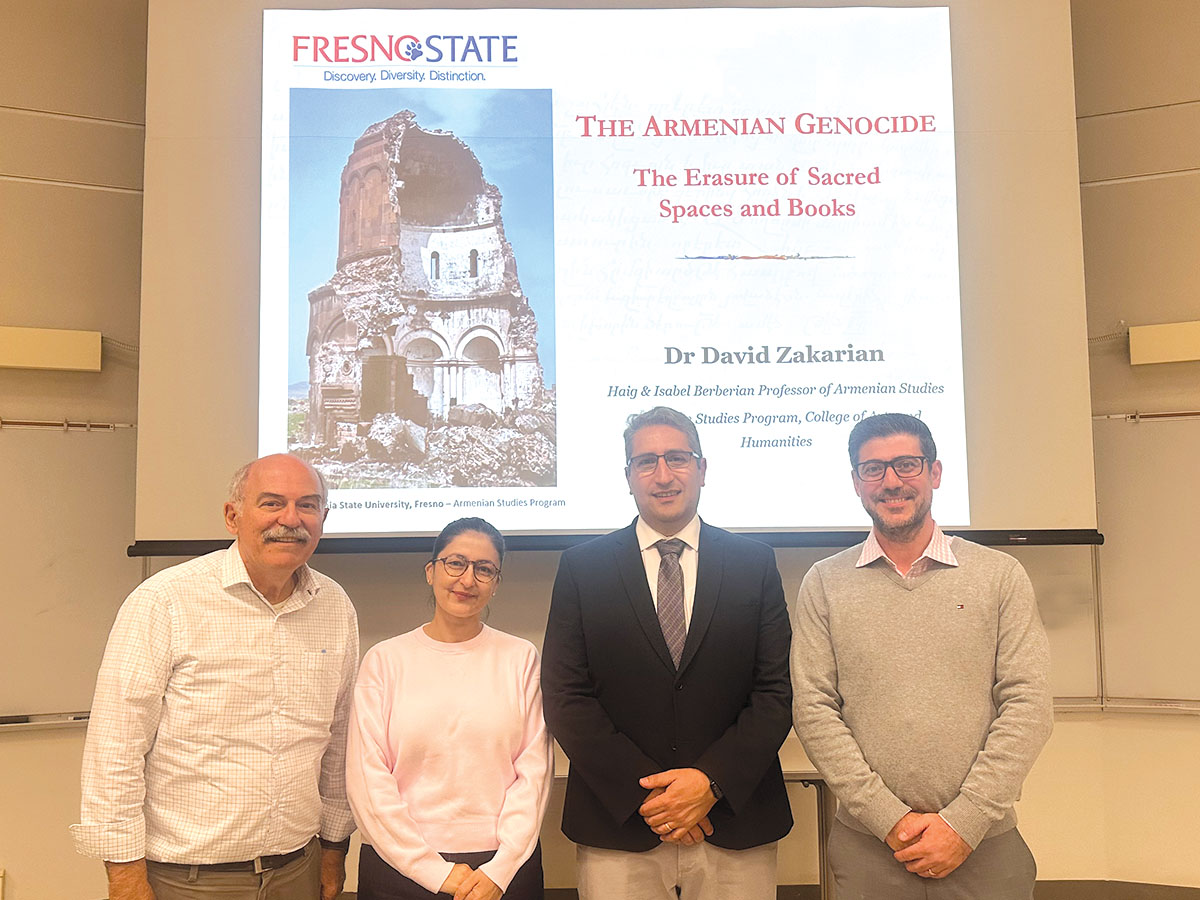
The week of April 24th is marked by memorials, acts of awareness, and commemorations for Armenian communities around the world. On Tuesday, April 21, Dr. David Zakarian, Haig and Isabel Berberian Professor of Armenian Studies at Fresno State, presented a lecture titled “The Armenian Genocide: Erasure of Sacred Spaces and Books” to honor the victims, emphasizing that remembrance ensures their existence is not reduced to statistics.
The event, organized by Dr. Hagop Ohanessian and Rocio Solis, was hosted in the multipurpose room at Madera Community College. Upon arrival, guests were welcomed by the organizing committee and invited to explore a gallery featuring posters with facts about the Armenian Genocide, as well as tables displaying artifacts and family heirlooms.
Following an introduction by Dr. Hagop Ohanessian, Dr. Zakarian began his lecture. In his opening remarks, he shared that when he first pursued Armenian studies, he avoided focusing on the Genocide because it felt too emotional. “The more I started working with medieval manuscripts, though, the more I realized I had to face it,” Dr. Zakarian explained. The gaps in historical records and the destruction of thousands of years of culture made confronting the subject unavoidable.
When defining “genocide,” Dr. Zakarian referenced the Cambridge Online Dictionary, which defines it as the “intentional destruction of a group of people.” The term was coined by Raphael Lemkin between 1943 and 1944, combining the Greek word genos (race) and the Latin suffix -cide (kill). Dr. Zakaria also cited Article II of the United Nations Genocide Convention, which outlines the criteria that constitute genocide.
Dr. Zakarian then provided historical context for the Armenian Genocide, highlighting its complexity and the multiple factors that contributed to it during World War I. He referenced precursors to the genocide, such as the Young Turk Revolution, origins of Pan-Turkism, and the initial deportations of intellectuals. “The descendants of the perpetrators deny it still,” said Dr. Zakarian when referencing how the repercussions of the genocide affect current diplomatic relations and recognition. He dis-played various maps of Armenian deportation paths, and briefly discussed the Ottoman Empire’s “justifications” for their violent and enforced actions.
Despite attempts at erasure, Armenians have been proactive in preserving and documenting their history. The Church of Armenia, written by Malachia Ormanian in 1912, provides a form of census for Armenians around the world. After the genocide, it could serve as a reference point for Armenian populations – identifying communities, places of refuge for displaced people, and offering a historical record of the widespread Armenian presence across different regions.
Prior to the genocide, approximately 62,500 manuscripts were known to exist; afterward, only about 31,000 remained. This dramatic loss reflects the scale of cultural erasure, not just in terms of lives, but in the destruction of historical memory.
One particularly powerful example is the Mush Lectionary, a massive manuscript that was carried by two sisters during the Genocide. In their effort to protect a piece of their cultural and religious heritage, they transported it under extreme conditions. Eventually, it was brought to the Mother See of Holy Etchmiadzin, and later to the Matenadaran, where it is kept today.
Physical sites, often churches, are also subject to destruction. The Khtskonk Monastery (7-13th c.) was a monastic site composed of five churches, all intact in 1920. By 1959, four of the five churches had been demolished by the Turkish government, evidence of deliberate destruction. Dr. Zakarian featured an image of the remaining church, which had been violated with graffiti, removal of crosses, and evidence of looting. He also showed the St. Karapet Monastery of Mush (4-18th c.), which is now a Kurdish village. These examples demonstrate an active attempt to not only erase the existence, but “the memory of the people who created it.”
With limited global recognition and the continued challenges facing Armenia and its surrounding regions, Dr. Zakarian emphasized the importance of preservation, education, and awareness.
The audience remained highly engaged throughout the lecture and posed many insightful questions about the future of Armenia, its relations with neighboring regions, and what both Armenians and non-Armenians can do to help raise awareness.