
In 2023, data from the U.S. Bureau of Labor Statistics found that women make up around 16% of engineers and architects worldwide. The World Economic Forum’s 2024 Global Gender Gap Report also found that women accounted for just 20.4% of U.S. graduates in engineering, manufacturing and construction programs.
These scarce numbers trickle down to local universities, like Fresno State.
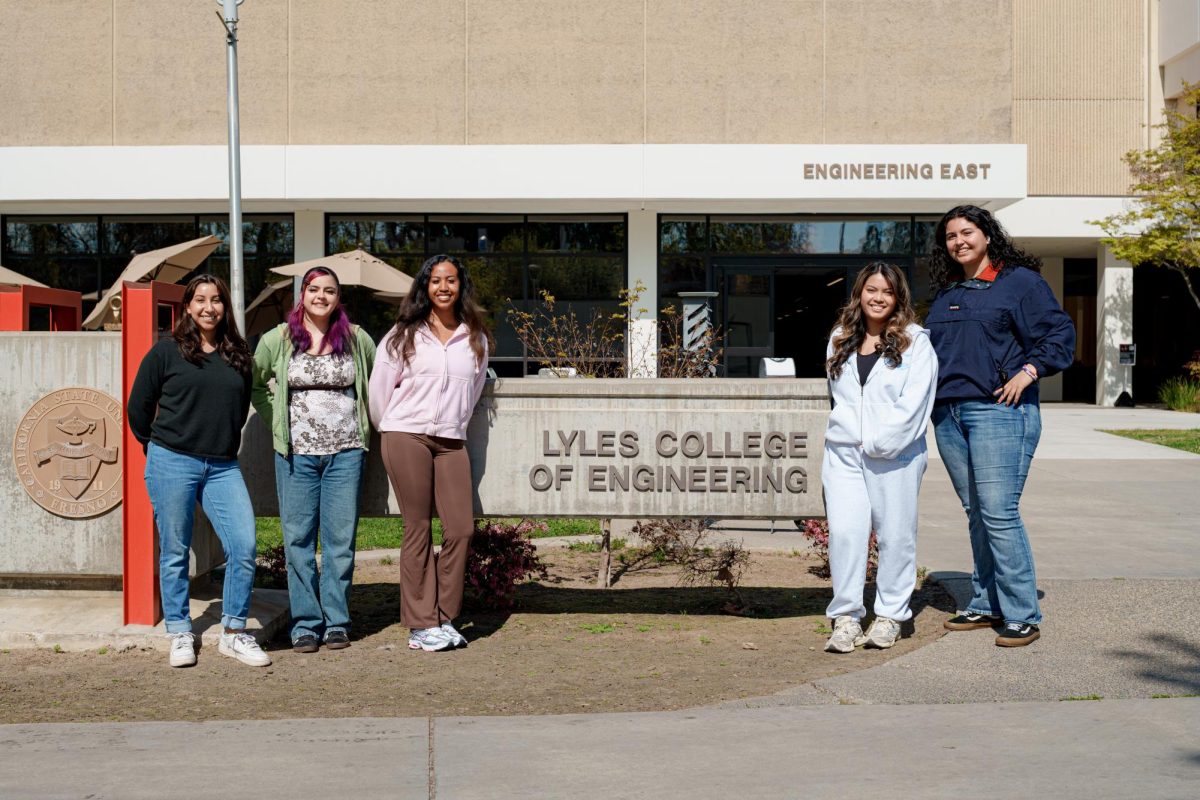
Students in Fresno State’s Lyles College of Engineering say their experiences reflect both progress and challenges for women in the field. 
Several students said the programs are growing, but engineering spaces can still feel male-dominated. Classrooms, labs and internships still reflect the imbalance many students feel, as the shift is noticeable, but representation still feels uneven.
Natasha Iqbal, a junior in geomatics engineering, said she struggles at times to get hands-on experience in fieldwork labs, and that assumptions about women’s physical ability can affect how work gets divided.
“I’ve had times where I’ve been told I should just sit there and look pretty while the men handle equipment,” Iqbal said.
She said situations like that make it harder to gain practice using the tools needed for surveying work.
Workplace surveys suggest those experiences are not uncommon. According to the American Society of Mechanical Engineers, 73% of female engineers reported experiencing some form of discrimination, harassment or victimization in a professional setting.
Iqbal said being overlooked for technical tasks can be frustrating because field experience is a key part of preparing for the profession. She wants to be judged on her ability, not assumptions. She added that equal access to training is important because those early experiences can shape confidence going into internships or jobs.
Other students said they have experienced being underestimated in academic settings. Alexis Publico, a senior mechanical engineering major, said she has had classmates assume she wasn’t serious about the major.
“I’ve gotten comments like ‘I thought you were dumb’ or that I give ditsy vibes,” Publico said.
Publico also said some people assumed she was only in the engineering building to see friends, rather than because she was an engineering student.
Publico said those reactions didn’t stop her from continuing in the program; she has never failed a class and is graduating with a strong GPA.
“My advice for women in engineering is not to let people pull you down or underestimate you,” Publico said. “Believe in yourself, because if you don’t, no one else will.”
Leilah Hunt, a junior mechanical engineering major, said she noticed bias earlier in her academic career, especially in high school group projects, and that she was often assigned administrative roles instead of technical ones.
“In group projects, most of the guys would automatically give me the secretary role or ask me to take notes,” Hunt said.
She learned she had to speak confidently or her ideas would be dismissed.
Hunt said those experiences pushed her to develop leadership skills, and that, in many of her college group projects, she now ends up leading and delegating tasks.
“I usually end up leading the project,” Hunt said. “It gives me experience, but it’s also frustrating sometimes.”
Hunt said mentorship also played a big role in her path. She said a high school mentor encouraged her to pursue engineering and that a female professor at Fresno City College influenced her interest in teaching in the future.
Students also pointed to the gender imbalance in classrooms. Jocelyne Solano, a senior electrical engineering major, said many of her classes still have mostly male students.
“Most of the time when you walk into class, the majority of your peers are men,” Solano said.
She said that the environment can make women feel like they don’t belong.
Long-term data show women’s participation in engineering has increased in recent years, but remains uneven. According to the Society of Women Engineers, women represented about 3% of the engineering workforce in 1970 and roughly 15-16% by 2023. Women now earn about 23% of engineering degrees nationwide.
Solano said she sees that imbalance as motivation.
“Being a woman in engineering means that change is occurring, starting with you,” Solano said.
She said visibility can encourage younger students to consider engineering paths they might not have otherwise imagined.
Some students said the difference becomes even clearer once they enter professional settings. Sydney Rivera, a senior electrical engineering major, said she noticed this during her first engineering internship.
“I was the only woman on the engineering team,” Rivera said.
She said the manufacturing plant environment felt fast-paced and male-dominated.
Rivera said she felt pressure to prove she belonged.
“I didn’t want to be known as the ‘girl engineer,’” Rivera said. “I wanted to be known for my work.”
She said confidence didn’t come immediately, but it grew over time as she gained more experience. Continuing to show up prepared helped her build trust and feel more comfortable in the workplace, and those moments helped her better understand what the industry expects from new engineers.
Other research has identified workplace culture as a factor in retention. A University of California, Riverside study found that about half of women in technical fields cited unsupportive supervisors and limited advancement opportunities.
“You don’t always start out feeling like you completely belong,” Rivera said. “You build that feeling by doing the work and trusting your ability.”
While each student’s experience is different, many said they have noticed more women entering Fresno State’s engineering programs in recent years. They said support from professors, mentors and classmates can make a difference in helping students stay in demanding STEM majors.
As Women’s History Month highlights women across different fields, these students said their presence in engineering reflects steady change. Rivera said it’s not happening overnight, but it is happening.
“Every woman who sticks with it makes it easier for the next one,” Rivera said.