


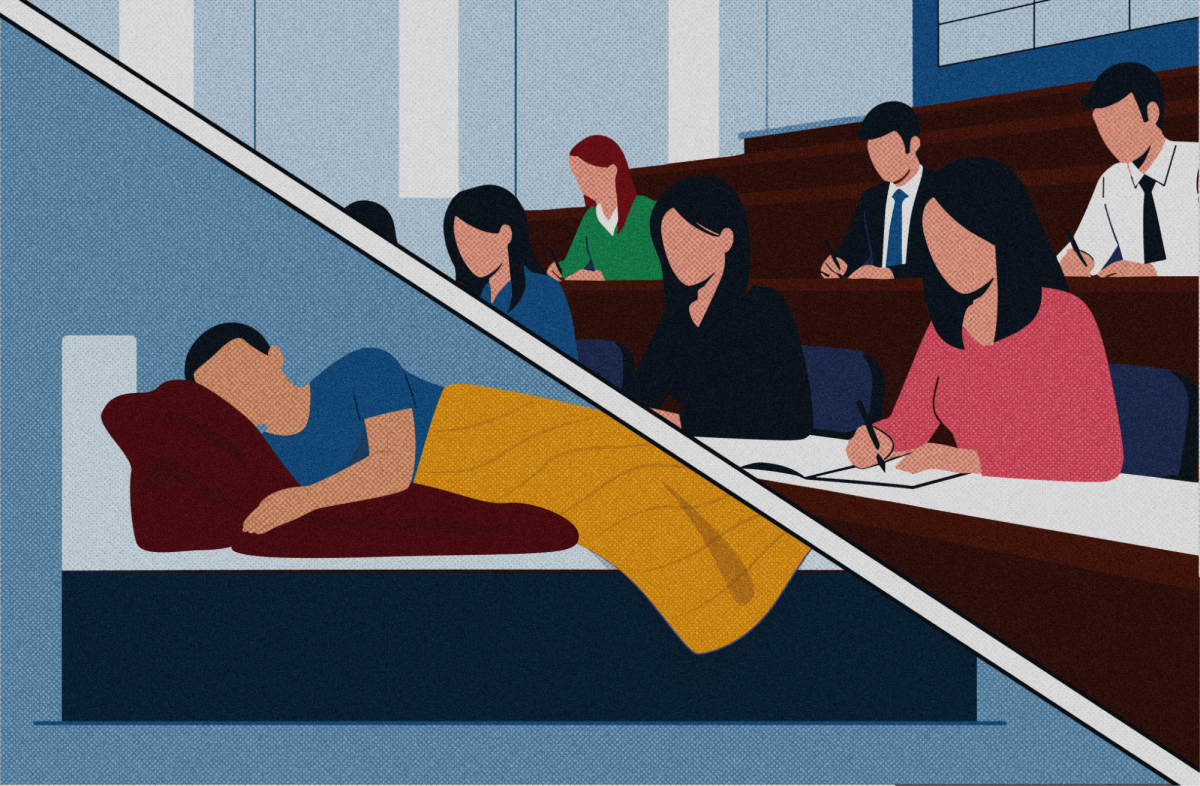
Paloma Schuller: Victor, I get it. Your bed is warm, your alarm is rude and the idea of dragging yourself across campus at 8 a.m. feels nothing short of a personal attack.
But hear me out, you should still go. Not because you have to, but because what happens in that classroom can only happen when you’re actually in it.
Professors don’t come alive in empty rooms. Their best explanations, their impromptu demos, their willingness to slow down and answer real questions, all of that happens when students actually show up for class and fill the seats.
After all, professors design a lot of their discussions, activities and demonstrations around live student participation. A half-empty room limits what professors can do.
Victor Fontes: Look, Paloma, my bed is comfy, and I hate my alarm, but it’s not about that.
I know the importance of taking my education seriously and with responsibility. After all, it is my education, my future, and I want to make sure what I’m doing now in college actually prepares me for my career path.
But simply put, my education is my responsibility. I am a legal adult. I can drive a car, buy alcohol, input my age into websites without lying about it and, most importantly, pay for my education, which in turn also pays for these educators to be there.
So, I should be able to go to my class whenever I like. Furthermore, life tends to happen. Burnout, family emergencies, work and everything else under the sun are all bound to occur, and it does all the time.
After serving my time as a Zoom student over the pandemic, I truly understand how an empty classroom can inhibit an educator’s work.
It’s tough, I’ll admit. But in my experience, a good and/or clever professor doesn’t need mandatory attendance to keep a class from skipping out.
Paloma Schuller: I respect the whole “I’m a legal adult who can buy tequila and click ‘Yes, I am over 18’ without sweating” argument – truly, I get it.
Let’s be honest here, adulthood is not the magical freedom pass you think it is, especially when it comes to education. If anything, adulthood is just paying for the things you don’t want and showing up to the things you’d rather skip. Now that is adulthood.
If schools made attendance optional just because we’re “grown-ups” now, half of us would be doing our so-called “education” under a blanket in bed. Half of us would be googling “what are mitochondria again?” one hour before the final.
Sure, life happens, burnout, family emergencies, cosmic chaos, Mercury in retrograde, whatever. I mean, life always happens. If we used that as our guide, we’d never show up to anything ever again, including birthdays, dentist appointments and jobs that pay for the iced coffees keeping us alive.
Yes, Zoom was a dark time. But if anything, that showed us exactly why attendance matters, because staring at a grid of 24 black rectangles labeled “iPhone (2)” is just sad.
So yeah, you could go to class whenever you like, but if that were the rule, most of us wouldn’t “like to” very often. Mandatory attendance isn’t about control; it’s about saving us from our own terrible instincts and from the gravitational pull of our beds.
Victor Fontes: I would have to disagree with you. I think being an adult is the key to truly doing whatever you want with your life, as we all have free will in this world; it just depends on what you do with it. You can choose to act irresponsibly or take accountability for yourself and build your future.
Adulthood is simply the opportunity to learn how to truly be an adult, and some people don’t take it. If some students want to spend their time and money cheating in college and staying home the whole time, that is on them.
This argument is not for those people, as they should not be in college in the first place if they don’t want to put in the work to earn their degree. Also, if they truly don’t want to go in person, they can just take an online course.
However, those people are not me. I’m paying thousands of dollars every six months. I take in-person classes only. I want that experience and to educate myself, but I don’t want my grades stunted for when I feel it’s valid to spend my time doing other things that are, more often than not, more important.
To clarify, I’ve missed class for good reasons, whether that be family-related or for my own mental health. Additionally, I know many professors have policies in place for missed classes under valid reasons if you email them, or they allow a certain number of unexcused absences.
However, not every professor provides that grace period, and six months is a long time; a lot can happen in a semester. I am not trying to stunt my education, and I know what consequences await my actions, but it should fall on my own ability to learn and catch up, not be at the liberty of the teacher to dock me further.
Even when life happens, as you said it perfectly, life always happens; I should not worry about how badly my grade will suffer along with whatever I missed.
Paloma Schuller: Well, I admire your confidence. Saying “adulthood is the pass to do whatever you want” is quite bold! But let’s be real: adulthood is the pass to do whatever you want as long as you also file your taxes, floss your teeth occasionally and pretend you understand your health insurance plan.
Free will is great, but it has a bedtime. You say you take in-person classes only because you value the experience, but even the most dedicated scholar can be defeated by: one, a bad night of sleep, or two, the sheer gravitational force of scrolling on TikTok.
Humans simply cannot be trusted with the “optional attendance” button. If we had that much freedom, half of campus would evolve into cryptids who only emerge for midterms and free pizza.
As for missing class for “valid reasons,” I hear you. But that’s exactly why attendance policies already come with excused absences. Mandatory attendance doesn’t mean professors expect you to teleport in while dealing with a family crisis. It just means “please show up when you reasonably can,” not “live your life in fear that one missed class will vaporize your GPA.”
If anything, mandatory attendance saves us from the most dangerous force known to mankind: our own decision-making at 7:45 a.m.
Victor Fontes: I believe you understand my point then, but to a fault. Yes, those are the hurdles and requirements students need to get through, and yes, anyone can be taken down by some sleep deprivation and a lack of motivation.
However, that is exactly why mandatory attendance should not be required, so we, as people trying to learn how to function, can earn that discipline ourselves through our own resolve.
If I wanted to be regulated by mandatory attendance, I would go back to high school. I already gave college my money.
At Fresno City College, a good number of the professors I had treated the students as humans with their own autonomy. Many did not have mandatory attendance, but had full classes nonetheless, and it was free for me and everyone else I went to school with.
At Fresno State, I feel the sentiment should be similar, not more strict. “Please show up when you reasonably can,” is not what “mandatory” sounds like to me. Additionally, many teachers, instead of opting for strict attendance, provide in-class assignments that you must be present for. The only difference is that one can typically be made up when “life happens,” and one cannot.
Paloma Schuller: Well, Victor, I guess we’ll just have to agree to disagree. You’ll be in your bed learning “independence” from your pillow, and I’ll be in class learning from, you know, the person with the doctorate.
If adulthood really is all about choices, then congratulations, we’ve officially chosen different ones.