
Was there ever a screenshot of the signatures?
According to the official Campaign Worker Form, on behalf of Carlie Hall and the Next Step Slate’s Associated Students, Inc. (ASI) campaign, Aidan Brown, the secretary of the Pre-Medical Club at the time, was a certified campaign worker for the group, but we never saw his signature.
In fact, we never saw anyone’s signature, because the supposed screenshot with signatures proving whether or not this is true was never provided to anyone.
This incident in March was just one of the irregularities to occur in one of the most controversial Fresno State ASI presidential elections in recent history.
The election was marred by candidate violations by Hall, a lack of communication with The Collegian, the unexpected disappearance of James Martinez, the former ASI director of operations and threats of legal action on behalf of two different parties.
Some specifics included accusations of bribery and quid pro quo, a demand for a vote recount and the convening of a president’s committee and student court that never resolved anything.
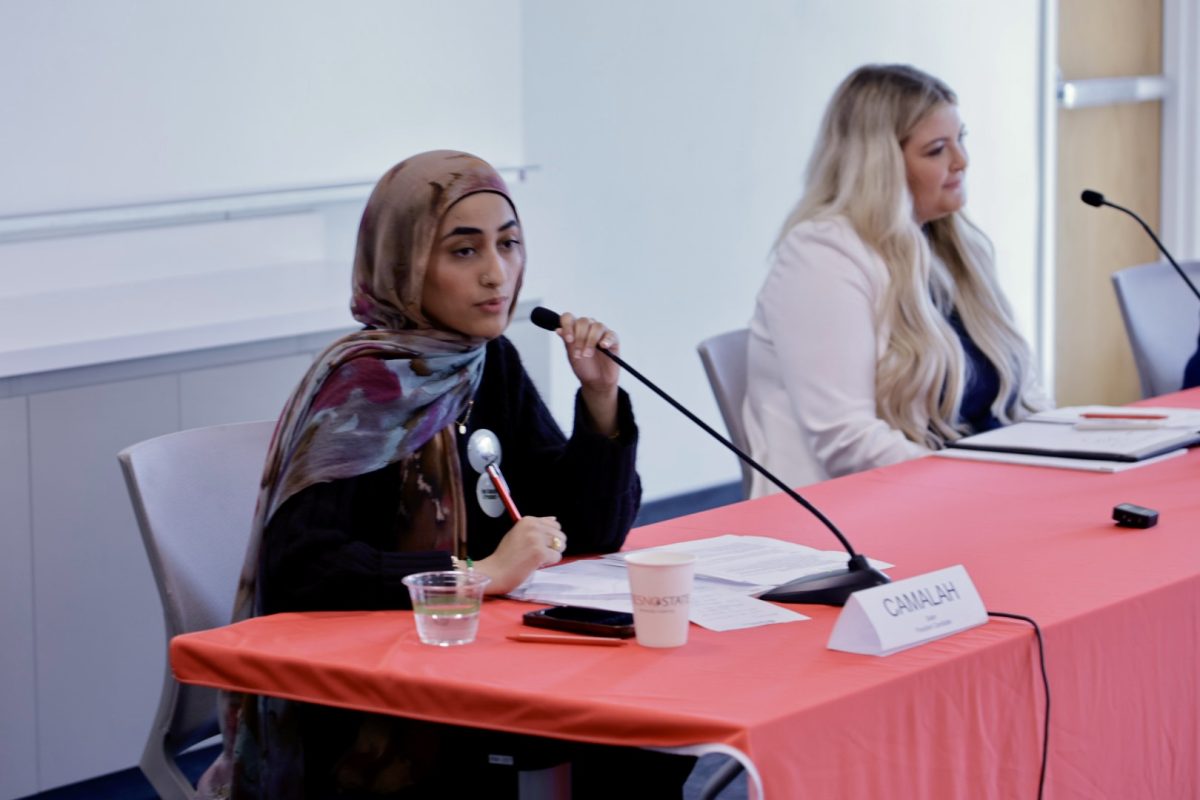
With all of the baggage, the three-way presidential race between Hall, Guadalupe Zamudio Telles and Camalah Saleh concluded with a substantial victory for Saleh and a last-place finish for Hall. 
And on May 9, just a little over a month after the election results were announced, Martinez resigned from his position with ASI.
For the first time, after diligent reporting, The Collegian is able to provide an overview of what happened. This account is based on dozens of interviews and numerous public documents, some of them available for the first time.
Here’s a recap of the election and why things got so hectic.
On March 25, Brown, who was listed as a “certified campaign worker” for Next Step Slate, filed a formal complaint with ASI, alleging that Saleh had committed quid pro quo and bribery.
Brown claims that Saleh approached Amna Khan, the club president, and bribed her with $2,000 from ASI in exchange for endorsement from the club and for its members to vote for her.
Brown cited the Pre-Med Club’s meeting minutes from Jan. 27 as proof for his complaint. However, after the ASI election commission conducted an investigation, the meeting minutes Brown submitted were deemed falsified.
After the investigation, Mary Davis, the ASI election commissioner, and Martinez determined that there were no quid pro quo actions, and Saleh did not bribe the club to endorse her. Khan acted under her jurisdiction to issue an endorsement on behalf of the entire club, as stated in the Pre-Med club bylaws. She also submitted a version of the club’s meeting minutes that were deemed the official minutes.
ASI declared that, under the election code, Hall and her slate were responsible for Brown’s actions in election misconduct, thus in direct violation of the election code.
This ruling was based on a document listing all of the Next Step Slate’s campaign workers, including Brown; however, the document did not include anyone’s signature. Hall wrote on the document, “screenshot attached for sigs,” but never provided it. The signatures would have made the documents official and solidified Brown’s campaign worker status.
To this day, no one knows where that screenshot of signatures is, or if it ever existed.
Certified campaign worker aftermath
The Collegian published a story about the situation on March 29, but the night before was filled with upset phone calls and fact-checking.
In an effort to determine whether or not Brown was a certified campaign worker for the Next Step Slate, The Collegian reached out to Hall. She denied that he was part of her team.
This was contrary to the ASI ruling.
Brown called The Collegian on the phone that evening, worried about the publication of his name as someone who falsified club records. He denied falsifying any information and said that, according to Martinez, the investigation was still ongoing.
What didn’t add up was the fact that there was already an official ruling from ASI, saying the investigation was over and that a final verdict had been reached. So, The Collegian reached out to Martinez by email and in a text message to his personal cellphone at approximately 8:20 p.m. He responded by saying that contacting him past business hours was beyond “the boundaries of professional courtesy.”
He refused to answer whether or not the investigation was still ongoing. But, if it was still ongoing, why did ASI release an official ruling?
Instead, The Collegian received a screenshot from Martinez at 10:44 p.m. of an email from Brown to Larry Riley, the Pre-Med club adviser, saying that he agreed with all of the documents Khan sent to ASI. No further explanation was provided.
In May, weeks after the election was finalized, The Collegian learned new details.
While Martinez would not speak with The Collegian that night to confirm whether or not the investigation was still ongoing, he emailed Riley at 11:08 p.m., saying this:
“For the record, I want to clarify that this situation is still pending and remains under active review—particularly in light of the new information you’ve provided.”
In other words, Martinez told Riley that the investigation was still ongoing, after refusing to confirm that with The Collegian and after ASI had already made an official ruling.
So, did ASI officials make a premature ruling based on incomplete documents? Yes, they did, because if the screenshot of signatures was never provided, how were they confirming that Brown was a campaign worker?
The Student Court and the president’s committee
Because the situation was unresolved, the matter was referred to the Student Court.
According to the ASI bylaws, the Student Court was supposed to handle all ASI complaints and campaign violations. In this election, however, the court was not implemented, and election issues were handled by the election commissioner and the director of operations.
The ASI election was scheduled to begin on April 1 at 9 a.m.
The Student Court was scheduled to meet at 5:30 p.m. that day to discuss the pending campaign violation cases, but the meeting was canceled due to the court’s inability to meet quorum.
So, the No. 1 question at that point was why the ASI elections were proceeding while there were unresolved issues regarding the candidates. Also, why was it scheduled to meet after students had already had a full day to vote?
Regardless of whether the court was able to meet or not, the fact that the election wasn’t postponed jeopardizes its integrity, and it’s questionable if the election was even valid.
Since the court was unable to meet, President Saúl Jiménez-Sandoval designated a committee of faculty and students to handle the situation.
The committee was scheduled to meet at 10 a.m. on March 31, the day before the election, to review the documents regarding the Brown/Hall/Saleh situation and then communicate its verdict with Jiménez-Sandoval.
The meeting’s end time wasn’t confirmed with anyone and after asking several people what happened during the meeting, no one was able to provide a clear response until months later.
“After careful consideration of the information presented, I decided to return the matter back to ASI and asked that they reconstitute a student court to consider the questions raised in the appeal,” Jiménez-Sandoval wrote to The Collegian in an email statement regarding the meeting. “Because the matter was ultimately returned to ASI to carry out the election appeal process, no communication from the committee was ever formalized.”
At that time, the question remaining was whether or not the election was going to proceed as planned, due to the fact that there were several outstanding issues.
The answer was yes. On the night the committee met, Ashley Ilic, senior director of University Marketing and Communications, sent an email statement to The Collegian, stating that the election would proceed. But the issues at large were never resolved, and The Collegian still does not know why.
The outstanding factors included a bizarre scenario in which Hall and her slate handed out free PRIME drinks, even after being denied permission to do so by University Dining Services. It ended in a verbal confrontation between Hall and Amy Allen, the associate dean of student involvement, who alleged that she was struck by a PRIME inflatable.
As the election began on April 1, Martinez took a leave of absence, and Allen was appointed to the ASI Election Commission, taking on the duties of the ASI director until April 9.
This raised another question: Why was an administrator who had a direct conflict with one of the candidates chosen to serve in a role that directly oversaw the election?
“I was asked by campus leadership to provide temporary support to ASI during a period of staff transition, given my experience with student involvement and familiarity with ASI operations,” Allen wrote to The Collegian on Aug. 6.
Allen explained that although there was a “brief interaction” with a candidate that resulted in “an unsecured sign with large metal poles” hitting her back, the situation was “quickly resolved.”
On April 3, the morning of the last day of the election, Hall’s legal representative, Bradley Hertz, sent a formal letter to Jiménez-Sandoval, demanding that Allen be removed from her appointed position with ASI, or else litigation against the school would be considered.
Later that same day, Saleh was selected as the ASI president-elect, taking 46% of the vote.
Post-election reactions
On April 7, Hertz demanded an official recount of the votes on Hall’s behalf, stating that the ASI election was mishandled on several grounds.
The reconstituted Student Court met on April 11 to discuss all of the formal complaints and violations regarding the ASI election, which is what the court was supposed to do from the beginning.
At the meeting, Hertz was denied the opportunity to speak on behalf of the Next Step Slate, and Hall’s demand for a recount was denied. The court moved to adjourn the meeting and did not discuss any of the other items on the agenda.
The Collegian contacted Hall to further discuss the election, but she denied the request.
“I am really not interested in communicating for any Collegian purposes, considering the way things have been painted previously, and the fact that you guys have [been] uncooperative in clearing the record on any false or misleading reports,” Hall said.
The Collegian’s involvement
Throughout the election process, The Collegian remained impartial and reported solely based on facts and official documents.
However, at a certain point, The Collegian inevitably became personally involved.
Brown threatened to sue the publication for defamation on the grounds that The Collegian’s story, “Saleh cleared of campaign charges as complaint backfires for Next Step Slate,” was untrue and harmful to his reputation, because he stands by his word that he did not falsify any club minutes.
However, with Khan submitting the official meeting minutes and being supported by several of the Pre-Med club officers, Riley and the officers agreed to recall Brown from his position with the club.
The Collegian asked Riley for a statement, but he declined to comment.
Brown, however, emailed this statement to The Collegian:
“I would like you to be aware that after the reporting in the spring, a formal complaint was filed against me with the Office of Student Rights and Responsibilities. After presenting my case and evidence and meeting with various administrators, I was found not responsible for any misconduct. No sanctions were imposed against me by the associate dean of students, the only person with the proper authority and jurisdiction in this matter; despite the reporting, ASI’s faulty rulings, and the Pre-Med Club’s premature actions.”
Brown never followed through with any legal proceedings.
Saleh in the president’s seat
After everything that happened, Saleh’s victory remains solid, and she says she is hopeful for her term, despite being targeted during the election.
“As unfortunate as it sounds, I went into the election preparing myself for that possibility,” Saleh said. “While you can never fully prepare for how it feels to be targeted for your values and identity, it’s something I’ve come to expect, something my communities constantly face.”
Saleh explained that while the election could have been handled better, the process moving forward is what matters.
“Last semester’s election led to a lot of needed changes, such as a new election code, new structures, and best of all, the voting turnout rate doubled, and the results for every position were by a wide margin, making the students’ choice loud and clear,” Saleh said.
Martinez’s resignation
While Martinez’s resignation on May 9 was sudden, it wasn’t surprising. He was at the front of the election, and instead of bridging the gap between administration, legal counsel and the student news publication, he went off the grid multiple times and lacked transparency.
The Collegian reached out for comment, and he did not respond.
Frederick Lisitsa, former ASI executive vice president, now serves as the ASI operations manager, a revamped position, formerly known as the ASI director of operations.
“Last semester’s election brought to light some difficult moments, but it also reminded me that student government is a reflection of our broader government and society,” Lisitsa said.